Venus Figurines and the Mother Goddess
October 25, 2026
Long before any goddess had a written name, people made figures of women. Some are more than 35,000 years old, carved from mammoth ivory or stone, or modelled in fired clay. Were they goddesses? The Ice Age figures considered here have no accompanying written explanations, so identifying them as goddesses remains a modern interpretation. This guide introduces the most important prehistoric female figures, from the Ice Age to the Bronze Age, explains the idea of the mother goddess and the debate around it, and shows the sculptures by Silvia Steiger that answer these figures in clay.
What we can and cannot know
Archaeology can tell us where a figure was found, what it is made of and roughly how old it is. Archaeological context can help us evaluate possible meanings, but it rarely establishes a figure's identity or purpose with certainty. The interpretations below, from fertility charm to self-portrait to goddess, are modern readings. Where a reading is widely shared it is named as such; where it is contested, this guide says so.
How old is old? Reading the dates
Ages for Ice Age figures are given in several ways, and they are easy to confuse. Radiocarbon dating measures the decay of carbon-14 in organic material such as bone or charcoal found in the same layer as a figure. The raw result, in radiocarbon years, has to be calibrated against other records to give calendar years, and for the Ice Age the two can differ by thousands of years. A figure carved from stone or ivory is usually dated by the layer it was found in, not by the object itself. When this guide says "about 30,000 years old", it means calendar years before the present, with a margin of uncertainty that the excavators publish. Dates "BCE" count from the beginning of our era instead, so 6000 BCE is about 8,000 years ago.
Ages also change as methods improve. The Venus of Willendorf was long dated to about 25,000 years; new dating of the find layer moved her to about 30,000 years. Such revisions are normal, and a precise-sounding number in an older book may no longer be current.
Ice Age figures: the "Venus" figurines
Archaeologists call the female figures of the Upper Palaeolithic "Venus figurines", a name chosen in the 19th century. Figures conventionally called Venus figurines occur across widely separated parts of Eurasia, with many familiar examples belonging to the Gravettian and earlier examples including Hohle Fels and Galgenberg.
The Venus of Hohle Fels
In 2008 a figure of a woman carved from mammoth ivory was found in the Hohle Fels cave in the Swabian Jura in Germany. About 6 centimetres long and at least 35,000 calendar years old, it is one of the earliest known sculptures of a female human body. In place of a head it has a small ring, so it may have been worn as a pendant.
The Galgenberg figure from Stratzing
Austria has one of the oldest figures as well: the Venus of Galgenberg, nicknamed "Fanny", found in 1988 near Stratzing in Lower Austria. The small figure, carved from greenish amphibolite schist, is about 7 centimetres tall and about 36,000 years old, and appears to show a woman in motion with one arm raised. It is in the Natural History Museum in Vienna.
The Venus of Willendorf
The most famous of all, the Venus of Willendorf, was found in 1908 in the Danube valley of the Wachau in Lower Austria. She is 11 centimetres tall, carved from limestone, about 30,000 years old, and has traces of red ochre. Her head has no facial features and is covered by a pattern interpreted as a hairstyle or headdress. She is in the Natural History Museum in Vienna. Read the full story of the Venus of Willendorf.
The Venus of Dolní Věstonice
In southern Moravia, about 29,000 years ago, people shaped and fired the clay figure now known as the Venus of Dolní Věstonice; a 2024 micro-CT study found no evidence of deliberately added bone or ivory temper. It is among the earliest known ceramic sculptures, made thousands of years before the earliest known pottery vessels. For a contemporary ceramic artist, these early fired-clay figures offer a point of connection with prehistoric makers, although they do not establish a continuous craft tradition.
Lespugue and Laussel
The Venus of Lespugue from the French Pyrenees, carved in mammoth ivory, exaggerates breasts and hips into an almost abstract form. The Venus of Laussel in the Dordogne is a relief carved into a limestone block: a woman holding a horn with thirteen notches, which some researchers read as a count of moons.
What did they mean?
Modern interpretations have linked some of these figures with fertility, childbirth and survival, but their functions remain debated. Others read them as charms for childbirth, as images of ideal health in times of hunger, as self-portraits seen from above, or as goddesses. These hypotheses draw on different kinds of evidence, and no single explanation has been established for all the figures.
When new analysis overturns old claims
Material studies can correct long-repeated statements. For decades the clay of the Venus of Dolní Věstonice was described as mixed with bone or bone ash. In 2024 researchers examined the figure with micro-computed tomography, which shows the inside of an object without damaging it, and found no evidence of deliberately added bone or ivory. The figure is made of local loess-based clay with natural inclusions. In the same way, petrological study showed that the stone of the Venus of Willendorf did not come from the Wachau where she was found. Each new analysis narrows what we can say about the makers, while the meaning of the figures stays open.
Why context matters
A figure that sits in a museum case has lost most of its story. Archaeologists therefore record exactly where it lay, what was found with it and whether it was whole or broken. Some figures come from living areas, others from pits or near hearths; some were deliberately broken, and many of the fired figures at Dolní Věstonice seem to have shattered in the fire. These details matter because a figure made to be worn, one made to be destroyed and one made to be kept may have served very different purposes. Comparing figures across thousands of years and kilometres, as the label "Venus figurines" invites, can hide such differences.
Neolithic figures and the first farmers
Neolithic communities made new kinds of human figures, but farming, settlement and figurine-making developed differently across regions. At Çatalhöyük in Anatolia, a seated clay woman rests her hands on felines, but identifying her as a goddess remains an interpretation. At Hal Saflieni on Malta, a small clay figure known as the Sleeping Lady lies on a couch. Vinča communities made clay human figures, while thousands of female statuettes are known from Cucuteni-Trypillia; such figures cannot automatically be identified as goddesses.
The idea of the mother goddess
In the 20th century the archaeologist Marija Gimbutas argued that Neolithic Europe worshipped a Great Goddess in a peaceful, woman-centred society, before Indo-European warriors arrived. Her books shaped the modern goddess movement. Archaeologists have challenged this reconstruction because a figure's sex, divine status and social meaning must be argued from its particular context rather than assumed from a universal goddess model. Later sources offer distinct examples of divine maternity: Hesiod describes Gaia and Rhea as mothers of gods, Roman evidence attests Magna Mater and the Matres, and the medieval Irish glossary Sanas Cormaic calls Ana the mother of the Irish gods. Words like "mother goddess" and "Muttergöttin" describe a pattern scholars see across many religions, not one single prehistoric deity.
Ancient evidence and modern reception
Since the 20th century, prehistoric female figures have found a second life. Artists, writers and the modern goddess movement have taken them up as images of the sacred feminine, and they appear on book covers, in exhibitions and as replicas. This reception is real and meaningful in its own right, but it is a modern response, not evidence of what the figures meant to their makers. Keeping the two apart lets both be taken seriously: the archaeological record with its uncertainties, and the contemporary art and spirituality that draw on it.
The Bronze Age: the Minoan snake goddess
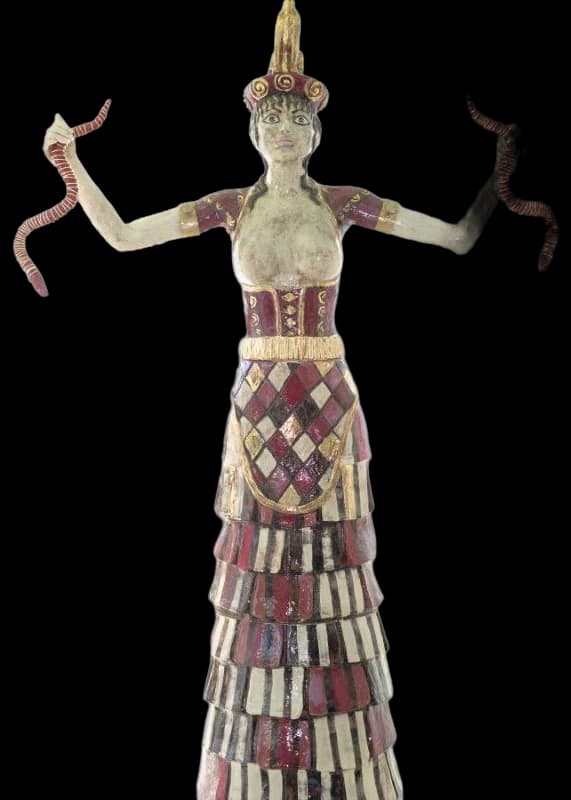
On Crete, Arthur Evans found faience figures of women holding snakes in the palace of Knossos in 1903; they date from about 1600 BCE. Evans called the larger one a snake goddess, but whether they show goddesses or priestesses remains debated, and parts of both figures were reconstructed. Explore the Snake Goddess and the homage sculpture.
Sun goddesses
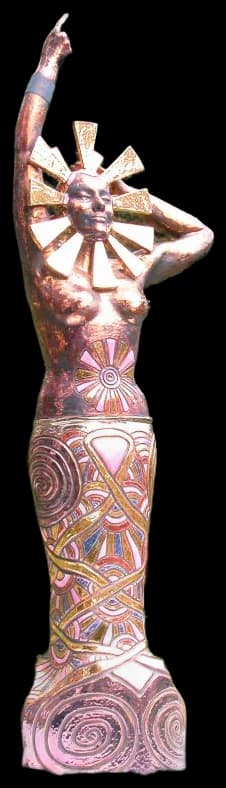
The following examples come from Bronze Age texts, later literature and recorded folklore; they do not establish the identity of prehistoric female figures. Several historically documented traditions include a female solar deity. The Hittites worshipped the Sun Goddess of Arinna as one of their highest deities. In the Norse Edda, Sól drives the sun across the sky, and the continental Merseburg Charm names Sunna. The Baltic peoples sang of Saulė, the sun mother, in their folk songs, and in Japan Amaterasu is the sun goddess from whom the imperial house traced its descent. Explore the sun goddess and her sculpture.
Answering the ancient figures in clay
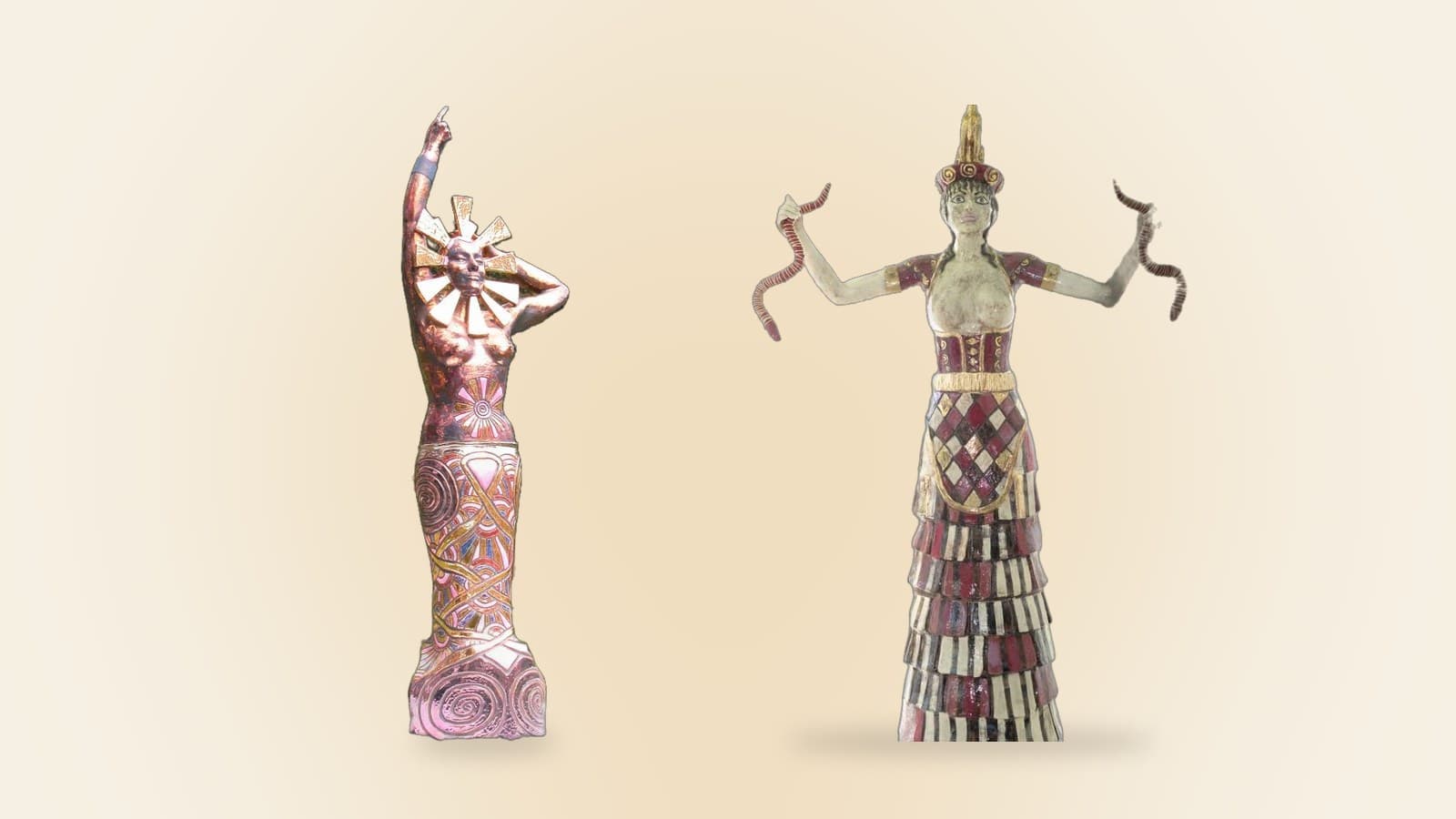
Silvia Steiger's ceramic sculptures offer a contemporary artistic response to ancient female imagery. Her monumental sun goddess, with raised arm and radiant crown, is a modern artistic interpretation, while her monumental Snake Goddess sculpture is an explicit homage to the Minoan figures. The sun goddess also exists as a small ceramic goddess, and the sun bull and sun lion continue the theme of the sun. You can see all the goddesses in the overview, and read how a monumental goddess is made. If a goddess speaks to you who is not yet among them, a commission is possible.
Frequently asked questions
What is the oldest Venus figurine?
The Venus of Hohle Fels from the Swabian Jura in Germany, carved from mammoth ivory and at least 35,000 years old, is one of the earliest known sculptures of a female human body. The Galgenberg figure from Lower Austria, about 36,000 years old, belongs to the same early period.
Why are they called Venus figurines?
The name goes back to the nineteenth century, when the Marquis de Vibraye called an ivory figurine from Laugerie-Basse in the Dordogne a “Vénus impudique”, an immodest Venus. The label was later applied to other Palaeolithic female figures. It reflects nineteenth-century ideas, not the intentions of the makers.
How many Venus figurines have been found?
A 2018 overview in the Anthropos Institute's bulletin reported more than 200 Venus figurines. Further discoveries have added to the known material: in 2019, the French Ministry of Culture reported a series of fifteen Gravettian statuettes from Amiens-Renancourt, the first discovered in 2014.
What do Venus figurines symbolise?
Their meaning is unknown. Modern interpretations include fertility, childbirth, survival, ideals of health and self-representation, but no single explanation has been established for all the figures.
What is a mother goddess?
In modern scholarship, “mother goddess” is a broad category for female deities associated with motherhood, birth, fertility or nurturing; ancient sources also give particular goddesses maternal titles. Written sources name several, such as Gaia, whom the Homeric Hymn to Earth calls the mother of all, Rhea, the mother of Zeus and his siblings in Hesiod, the Roman Magna Mater and Ana, whom Cormac's Glossary calls the mother of the Irish gods.
Who is the mother of all goddesses?
There is no single answer across religions. In Hesiod's Theogony, Gaia, Earth, bears the sky and the Titans, and through them the Olympian gods descend from her.
Sources
- Natural History Museum Vienna, Venus of Willendorf: Impressions of a Stone Age Icon
- Conard 2009, A female figurine from the basal Aurignacian of Hohle Fels Cave, Nature
- Weber et al. 2022, The Venus from Willendorf, Scientific Reports
- Moravian Museum, micro-CT study of the Venus of Dolní Věstonice (2024)
- Heraklion Archaeological Museum, the snake goddesses
- Hesiod, Theogony, tr. H. G. Evelyn-White
- Sculpture facts: atelier RHEAsilvia
- Homeric Hymn 30 to Earth, tr. H. G. Evelyn-White
- Venus figurine, overview with sources (history of the term)
- Anthropos Institute bulletin 58, December 2018
- French Ministry of Culture, Amiens discovery
- Getty AAT, mother goddesses
- Ovid, Fasti 4, Frazer translation
- Cormac's Glossary, text based on Stokes
- MNHN, Vénus dite impudique
- Musée national de Préhistoire, 2011 exhibition dossier