The First Goddess: What a 30,000-Year-Old Figurine from Austria Tells Us
July 17, 2026
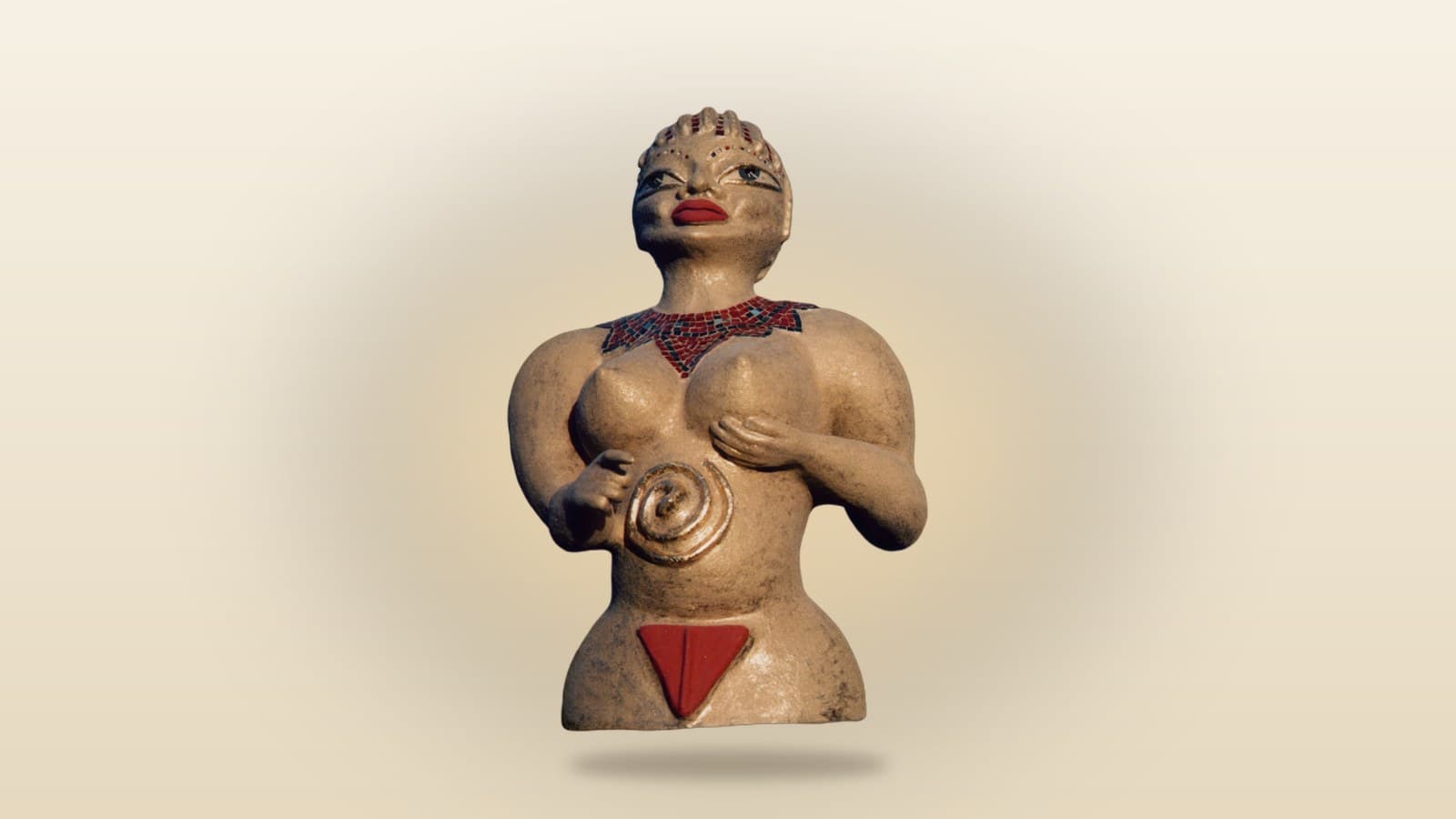
The first time I stood in front of her, I was surprised by how small she is. In the Natural History Museum in Vienna, behind glass, stands a figure of a woman just 11 centimetres tall, and around 30,000 years old. The Venus of Willendorf is the most famous ancient sculpture in the world. She was found here in Austria, in the Danube valley, not far from where I build my own goddesses out of clay.
A woman, found by the Danube
On 7 August 1908, during an excavation near the village of Willendorf in Lower Austria, a workman lifted a small limestone figure out of the loess. The archaeologist Josef Szombathy and his colleagues immediately understood that they were holding something extraordinary. The figurine is carved from oolitic limestone, a stone that does not occur in the region, so she or her stone had already travelled. She still carries traces of red ochre.
She is not a portrait. Her body is abundance itself: full breasts, belly, hips. Her face is hidden beneath what may be braided hair or a woven cap. Whoever made her, in the middle of the last Ice Age, was not carving a person. They were carving a power.
What did she mean?
The honest answer is: nobody knows. The name "Venus" was attached to her by men of the nineteenth and twentieth centuries, with a wink that says more about them than about her. Many researchers read her as a symbol of fertility, of survival, of the life-giving feminine. In a world where every birth and every winter was a matter of life and death, that reading makes sense to me as an artist. But I hold it lightly. She has kept her secret for 30,000 years, and that is part of her dignity.
What we do know: she is not alone. Hundreds of similar female figurines have been found across Europe, from the Pyrenees to Siberia, spanning tens of thousands of years. Long before the gods we know by name, before Zeus, before Odin, human hands were shaping the female form, again and again, in stone, ivory and clay.
The oldest craft there is
This is the part that moves me most: some of the oldest figurines in the world are ceramic. The Venus of Dolní Věstonice, found in Moravia, was formed from clay and fired almost 30,000 years ago, thousands of years before anyone made a clay pot. Human beings fired clay to make images of the goddess before they fired it to make anything useful.
When I build a goddess in my atelier, hollow, coil by coil, over many weeks, I am not copying these ancient works. But I am standing in their lineage, and I know it. Every goddess who leaves my atelier carries a little of Willendorf in her.
Meeting her yourself
If you are ever in Vienna, visit her. The Natural History Museum keeps her in a small, darkened room of her own, and she is worth the pilgrimage. And if you would like to see how her story continues in the present day, you are warmly invited to enter my temple: a gathering of goddesses in clay, each one of a kind, made a few hours' drive from the place where she slept in the earth for 30,000 years.