Goddess Sculptures: Meaning and Materials
October 25, 2026
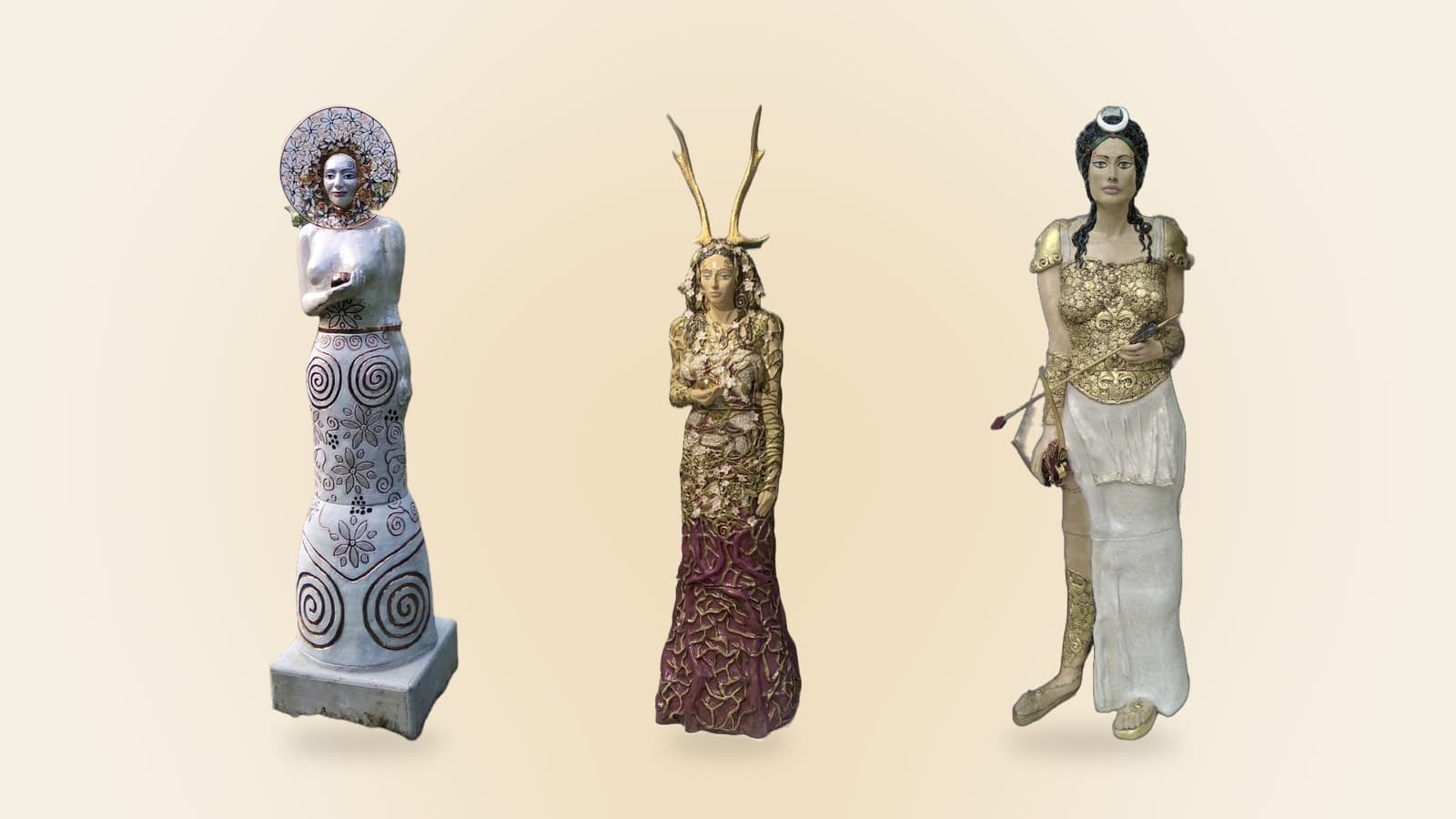
A goddess statue can be chosen as a work of art, a reminder of a story, or a focus for personal reflection. This guide explains what goddess images have meant in history, how the common materials differ, what to consider when you choose a sculpture, and how a monumental ceramic goddess is made in the atelier of Silvia Steiger in Pöttsching, Austria.
What a goddess statue means
Prehistoric female figurines survive, but their original meanings are uncertain and they cannot automatically be identified as goddesses. In ancient Greece, temples housed cult images of deities, and worshippers dedicated offerings in their sanctuaries. In Athens, the Panathenaic procession brought a newly woven garment to Athena's ancient wooden cult image. In Roman Britain, small ceramic figures of Venus were used for worship at home.
You can choose a goddess sculpture for its story, its appearance or its place in your own spiritual practice. Some questions help:
- A story: choose a myth that matters to you, such as Demeter's search for Persephone, or explore Freya's associations with fertility and magic.
- A quality: explore Athena's association with wisdom, Aphrodite's with love, or Artemis's with hunting.
- A practice: consider whether you want the figure as a focus for meditation or personal ritual.
- Heritage: explore figures associated with a region's religious traditions, such as Noreia in ancient Noricum or the goddess Brigid in Irish tradition.
- Art: the sculpture itself, its form, colour and surface, can be the reason.
There is no single correct meaning. A good starting point is the story of the goddess; our guides to Celtic, Norse and Germanic, Greek and prehistoric goddesses introduce them.
Reading a goddess's symbols
Many goddesses are recognised by what they carry or what accompanies them. Knowing the symbols helps you read a sculpture and choose between figures.
- The owl: in Greek tradition the owl is Athena's bird. In the Welsh Mabinogi, Blodeuwedd is turned into an owl as a punishment.
- Cats: in Snorri's Edda, Freya drives a chariot drawn by two cats.
- The cauldron: in the Welsh Tale of Taliesin, Cerridwen brews a cauldron of knowledge for a year and a day.
- Antlers: an antlered male figure appears on the first-century Pillar of the Boatmen in Paris, with the name conventionally restored as Cernunnos. Antlers on a goddess, as on Silvia Steiger's Lady of Avalon, belong to modern artistic interpretation.
- Snakes: the Minoan figures from Knossos hold snakes; whether they show goddesses or priestesses remains debated.
- The sun: several traditions know a female sun deity, such as Sól in the Norse Edda or the Sun Goddess of Arinna among the Hittites.
- The spindle: in German folklore, Frau Holle is connected with spinning and rewards diligent spinners.
Symbols can differ between sources, and one goddess can carry several of them. Our guides to Celtic, Norse and Germanic, Greek and prehistoric goddesses name the source of each attribute.
Materials compared
A sculpture's material, dimensions, construction and finish all affect its appearance and weight.
- Ceramic (fired clay): ceramic sculptures are made from clay that is shaped, dried and fired; some are glazed and fired again, while others remain unglazed. Clay can be shaped by hand or pressed into a mould. The Venus of Dolní Věstonice, a prehistoric female figurine made from fired clay, is among the earliest known ceramic sculptures.
- Bronze: bronze is a durable metal that can be cast from a model, either as an individual sculpture or in an edition; a bronze sculpture may be hollow.
- Stone: stone sculptures can be carved from marble and other rocks; marble was an important material in ancient Greek and Roman sculpture.
- Resin and cast stone: resin and cast stone are different materials, so ask the maker to identify the composition of a particular sculpture. Check whether the piece is cast and whether it belongs to an edition.
- Wood: wood can be carved into religious figures, as surviving examples from South Asia, Bali and New Guinea show.
Choosing a goddess sculpture
Size and place
Choose an indoor location before selecting a sculpture. For a small figure, consider a stable shelf or home altar. For a large figure, check its dimensions and discuss stable support and installation with the maker. The monumental goddesses of the atelier stand between 130 and 225 centimetres tall.
Light and view
A sculpture is seen in three dimensions, so think about how people will approach it, which sides they will be able to see, and whether its position lets you enjoy the details that first drew you to it. If there is room, leave space to walk around it, so that its back and sides can be seen as well. Light from one side shows the modelling of a surface more clearly than flat light from the front, and the glaze of a ceramic figure changes with the light through the day. A small figure on a shelf works best at or near eye level, where its details can be seen without bending down.
How the sculpture is made
Casting can produce multiple versions of a model, while hand-building shapes the sculpture directly in clay; the process alone does not establish whether a work belongs to a series. Ask the maker how a piece is produced and whether others like it exist.
Original, edition or replica
When you look at goddess statues, three kinds of objects meet:
- An original: a sculpture made directly by the artist, such as a hand-built ceramic figure.
- An edition: several casts from one model, often numbered and limited, as is common with bronze.
- A replica or reproduction: a copy of an existing work, for example a museum replica of an ancient figure, often cast in resin or plaster.
Each has its place. A museum replica of the Venus of Willendorf lets you hold the shape of a 30,000-year-old figure; an original sculpture adds the hand of a living artist. Ask which of the three you are looking at before you decide.
The goddess herself
Choose the goddess for her story, not only for her look. Read about her, look at how different artists have shown her, and ask which of her qualities you want in your space. If several goddesses appeal to you, reading their stories side by side can help; the guides linked above introduce the figures of each tradition together.
Questions to ask before you choose
- Which goddess is it, and which source or story does the sculpture refer to?
- What are the material, the height and the weight?
- Is the piece an original, part of an edition or a replica?
- How is it made: built by hand, cast or carved?
- Where will it stand indoors, and what support does it need there?
- How will it be packed and delivered?
- If the figure does not exist yet: can it be commissioned, and how long does that take?
Delivery
Ceramic sculptures can chip or break during handling and transport, so discuss suitable packing and delivery arrangements with the maker. The atelier's monumental goddesses are packed by hand and delivered by specialist art transport.
How a monumental ceramic goddess is made
A monumental goddess is a commitment of months. In the atelier of Silvia Steiger she is built hollow by hand in three parts and dried slowly. She is then fired two or three times in the kiln; clay, glaze and fire decide the final surface. Read how a monumental goddess is made.
Commissioning a goddess
If the goddess you have in mind does not exist yet, she can be commissioned. The process begins with a conversation about which goddess it should be and where she will stand. For a new commission, Silvia Steiger works out the figure with you before the first clay is touched, and you receive photographs from the atelier as she grows. Contact the atelier to discuss the size and complexity of your commission. Read how a commission works.
Small goddesses and jewellery
Not every goddess needs a large room. The atelier also makes small ceramic goddesses, made to order, among them Freya, Frau Holle, Aphrodite, Cerridwen, Blodeuwedd, the Lady of Avalon and the sun goddess, as well as goddess pendants in pewter and silver fairy pendants in 925 silver.
Frequently asked questions
What does a goddess statue symbolise?
A goddess statue can recall a myth or a quality associated with the goddess, or be chosen for its artistic form. Ancient Greek temples housed cult images of deities; the meanings of prehistoric female figurines remain uncertain.
Where should a goddess statue be placed?
Choose a stable indoor location where the sculpture is protected from knocks and tipping. For a monumental figure, discuss its dimensions, support and installation with the atelier before deciding where it will stand.
Are your goddess sculptures handmade?
Silvia Steiger makes hand-built ceramic goddesses in her atelier in Pöttsching, Austria. The monumental figures are built hollow in three parts and fired two or three times in the kiln.
How can I discuss a monumental goddess sculpture?
Send an enquiry about the goddess you have in mind and where she would stand indoors.
Before exploring the goddess overview and temple panorama, compare the figure's material, dimensions, construction and finish, and discuss its indoor support and delivery with the atelier. Explore the goddess overview and the temple panorama.
Sources
- Naturhistorisches Museum Wien, Venus research
- The Met, Greek gods and religious practices
- National Archaeological Museum Athens, a peplos for Athena
- London Museum, Roman ceramic Venus
- V&A, sculpture techniques
- Canadian Conservation Institute, caring for ceramics
- Kärnten Museum, votive altar to Noreia
- The Prose Edda, tr. R. B. Anderson
- The Mabinogion, tr. Charlotte Guest (1877))
- Heraklion Archaeological Museum, the snake goddesses
- Atelier facts: atelier RHEAsilvia