Lady of Avalon: Arthur, Morgen and Healing
October 25, 2026
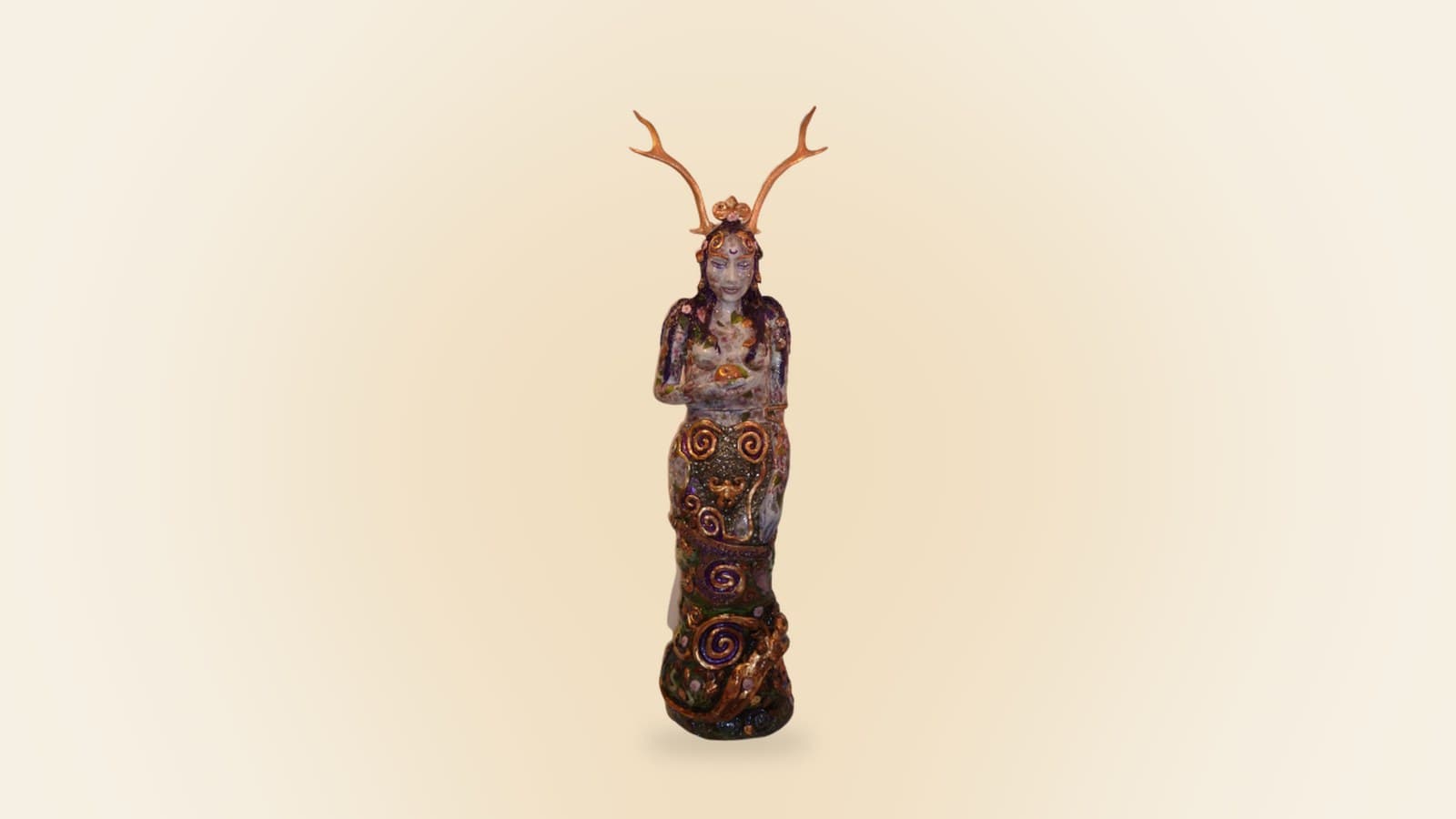
Somewhere behind the mists lies Avalon, the Isle of Apples. Geoffrey of Monmouth, writing in the twelfth century, made it the island where Arthur’s sword was forged and where the king was carried after his last battle. In his Life of Merlin, nine sisters rule the island; the first of them, Morgen, is the most skilled in the art of healing, and she can change her shape and fly through the air.
Avalon and Glastonbury
For many, Avalon has a place on the map: Glastonbury in Somerset, with its Tor rising out of the levels. Since the late twelfth century the town has been identified with the island of the legend. Today it is also a centre of the Goddess movement: the Glastonbury Goddess Temple opened there at Imbolc 2002 and has been a registered place of worship since 2003. In this artistic interpretation, the Lady of Avalon is the soul of the land itself: healer, keeper of the threshold, the one who receives what is wounded and gives it back whole.
Morgen and the healing of King Arthur
Geoffrey’s healing scene repays a slower reading. In the Latin Vita Merlini, Morgen uncovers Arthur’s wound with her own hand and studies it for a long time. Recovery is possible, she says, if he remains with her for an extended period and accepts treatment. The passage leaves him in her care. As a modern reading, its power lies in that interval: the wounded king must stop travelling and fighting, while the healer’s knowledge determines what happens next.
The journey itself depends on a different kind of expertise. Barinthus guides the party because he knows the waters and the stars. Arrival is followed by reception, examination and an agreement to leave Arthur behind. These practical actions sit beside Morgen’s extraordinary ability to change shape and fly. Geoffrey’s island thus makes room for navigation and sustained care as well as marvels. The text offers no reason to choose between the wonder of the destination and the skilled work required to reach it.
Glastonbury Abbey and Arthur’s alleged grave
Glastonbury adds a separate history of people making claims about Avalon. The abbey’s own archaeology account dates the announcement of Arthur and Guinevere’s grave to 1191 and names Gerald of Wales as a contemporary witness to the account. Its history also records the destructive fire of 1184 and the rebuilding that followed. The alleged royal remains belong to that medieval institution’s story. They should not be treated as excavated proof that Geoffrey’s healing island was a physical place.
Avalon in poetry and art
A later Arthurian voice changes the emphasis again. In Tennyson’s The Passing of Arthur, three queens receive the wounded king into a boat. One lays his head in her lap. Arthur speaks of travelling to Avilion to heal, but his own speech admits uncertainty. This is a nineteenth-century poem, not another medieval witness. It gives the departure emotional weight through farewell, bodily care and the unresolved question of whether the king will return.
Avalon also became a subject of visual art. The Museo de Arte de Ponce dates Edward Burne-Jones’s The Sleep of King Arthur in Avalon to 1881 to 1898. Its collection account connects the work with a commission from George Howard and notes that it remained unfinished at the artist’s death. The work is a specific example of Avalon’s later artistic life. It gives context for responding to the legend through an image, without establishing a direct influence on RHEAsilvia.
The Goddess Temple and Lady of Avalon sculpture
The Goddess Temple supplies contemporary religious context for this sculpture’s stated destination. Its own account describes a community reimagining the divine feminine since the 1980s, followed by temporary temple spaces in 2000 and the opening of its permanent worship space in 2002. That testimony explains how Avalon is understood by this modern community. It should be read as the community’s account of itself, without turning its beliefs about indigenous divinity into independently demonstrated medieval history.
RHEAsilvia made this Lady of Avalon for the Goddess Temple in Glastonbury. She is built by hand from clay in three parts and fired twice, and with her antlers she stands 180 centimetres tall. Her sister, Lady of Avalon II, is a separate sculpture.
Frequently asked questions
What is the myth of Avalon?
Avalon is the otherworld island of Arthurian legend. Geoffrey of Monmouth calls it the Isle of Apples, also named the Fortunate Isle: nine sisters rule there, led by Morgen, the most skilled in healing. Arthur is carried there, gravely wounded, after the battle of Camlann.
Where is Avalon?
In the legends it is an otherworld island. Since the late twelfth century it has been identified with Glastonbury in Somerset, after the monks of Glastonbury Abbey claimed around 1190 to have found the grave of Arthur and Guinevere. Modern historians regard that find as a probable forgery.
What does the name Avalon mean?
It is usually linked to the Welsh word for apple tree, afallen. Geoffrey of Monmouth himself calls Avalon the Isle of Apples.
Who is the Lady of Avalon?
Geoffrey of Monmouth names no goddess with that title: in his Life of Merlin the island is ruled by Morgen and her eight sisters. A thirteenth-century French text, the Prophecies of Merlin, already speaks of a Lady of Avalon. This sculpture shows her crowned with antlers: an artistic interpretation.
Are Lady of Avalon I and Lady of Avalon II the same sculpture?
No. Lady of Avalon I, 180 cm with antlers, was made for the Goddess Temple in Glastonbury. Lady of Avalon II is a separate work, 225 cm with antlers.
Does Morgen promise to heal Arthur immediately?
No. In the Vita Merlini passage she makes recovery dependent on a long stay and acceptance of her treatment. The scene ends with Arthur entrusted to her. It does not narrate an immediate cure or his subsequent return.
Why does Glastonbury matter to Avalon’s history?
The abbey announced the alleged discovery of Arthur and Guinevere’s grave in 1191. The claimed remains then occupied an honoured tomb in its church. That is evidence of a medieval Arthurian association at Glastonbury, rather than proof of the legendary king’s burial.
How has Avalon been represented in later art?
Tennyson’s poem places three queens beside the departing Arthur. Burne-Jones’s The Sleep of King Arthur in Avalon gives the subject a visual form, dated 1881 to 1898 by the holding museum. These are later responses to Arthurian tradition; neither is evidence for an ancient goddess cult.
See the sculpture: Lady of Avalon I
Sources
- Geoffrey of Monmouth, Vita Merlini (c. 1150), lines 908–940 with English translation (Camelot Project, University of Rochester)
- Geoffrey of Monmouth, Historia Regum Britanniae (c. 1136), excerpts: Caliburn made in the Isle of Avalon (Camelot Project)
- Avalon: Geoffrey’s Historia Regum Britanniae, Glastonbury and the name (Wikipedia)
- Glastonbury Goddess Temple, our story
- Sculpture facts: atelier RHEAsilvia
- Glastonbury Abbey, Arthur’s Tomb: the 1191 announcement, alleged remains and later memorial
- Glastonbury Abbey, History: the fire of 1184 and medieval rebuilding
- Alfred, Lord Tennyson, The Passing of Arthur, Idylls of the King, text hosted by the University of Rochester’s Camelot Project
- Museo de Arte de Ponce, The Sleep of King Arthur in Avalon, Edward Coley Burne-Jones, collection record, dated 1881 to 1898