FREYA, Norse goddess of love and beauty, goddess of war and death, mistress of magic
Freya (also Freyja, Old Norse for “Lady”) is one of the most important and many-layered goddesses of Norse mythology. In her, love and death, abundance and magic belong together. Two cats draw her chariot, she wears the golden necklace Brísingamen, and in her falcon cloak she flies through the worlds. People call on her in matters of love, and on the battlefield she receives the fallen.
Main aspects and meaning
- Goddess of love and beauty: She stands for fertility, sensuality, prosperity, happiness and sexual desire.
- Goddess of war and death: Unlike goddesses of love alone, Freya is also a warrior goddess. She shares the fallen heroes of battle equally with Odin and receives them in her hall Sessrúmnir in the field of Fólkvangr.
- Mistress of magic: She commands seiðr (a form of Norse shamanic and seeress magic), with which fate can be influenced. The myth tells that Freya was the first to teach this art to the Æsir.
Origin and family
- Family: She is the daughter of the sea god Njörd and the twin sister of Freyr.
- Origin: She belongs to the divine race of the Vanir.
Unlike the Æsir, who focus on battle and order, the older Vanir are bound to the earth, peace-loving and wise. They are gods of agriculture, of plants and animals, of fertility, of seafaring and of prosperity.
In the Vanir lives the older world of the fields, the herds and the sea, in which female earth and life deities (such as Freya and Nerthus) held a more central role than in the younger warrior upper class of the Æsir.
So Freya carries the old wisdom of the earth into the world of the Æsir. Her realm reaches far beyond one single domain. She holds the whole circle of life: love and birth, abundance and loss, death and return.
Symbols
- Brísingamen: Her magnificent golden necklace, forged by dwarves, stands for beauty, wealth and magic.
- Cat chariot: Two cats draw her chariot and symbolise independence, fertility and sensuality.
- Falcon cloak: A feather garment with which she can fly like a falcon through the worlds; it stands for transformation and shamanism.
Freya’s golden tears
Freya is married to Óðr. When he travelled far away, she wept for him, and her tears turned to red gold. This is why the old poets call gold “Freya’s tears”. She went in search of him through many lands and took many names among strange peoples: Mardöll, Hörn, Gefn and Sýr. Her daughters are Hnoss, the treasure, and Gersemi, the jewel, as precious as the gold of her tears.
Here the depth of the goddess shows itself. Love and the pain of longing belong to her as gold and abundance do. Whoever calls on her in matters of love calls on a goddess who herself knows love and loss.
Fólkvangr, the field of the people
Freya’s dwelling is Fólkvangr, and her hall is Sessrúmnir, spacious and beautiful. When she rides to battle, half of the slain belong to her and the other half to Odin. The goddess of love is also the goddess who takes the souls of the fallen into her realm. Life and death lie in her hands, and she decides where the dead are seated in her hall.
The Freya II sculpture
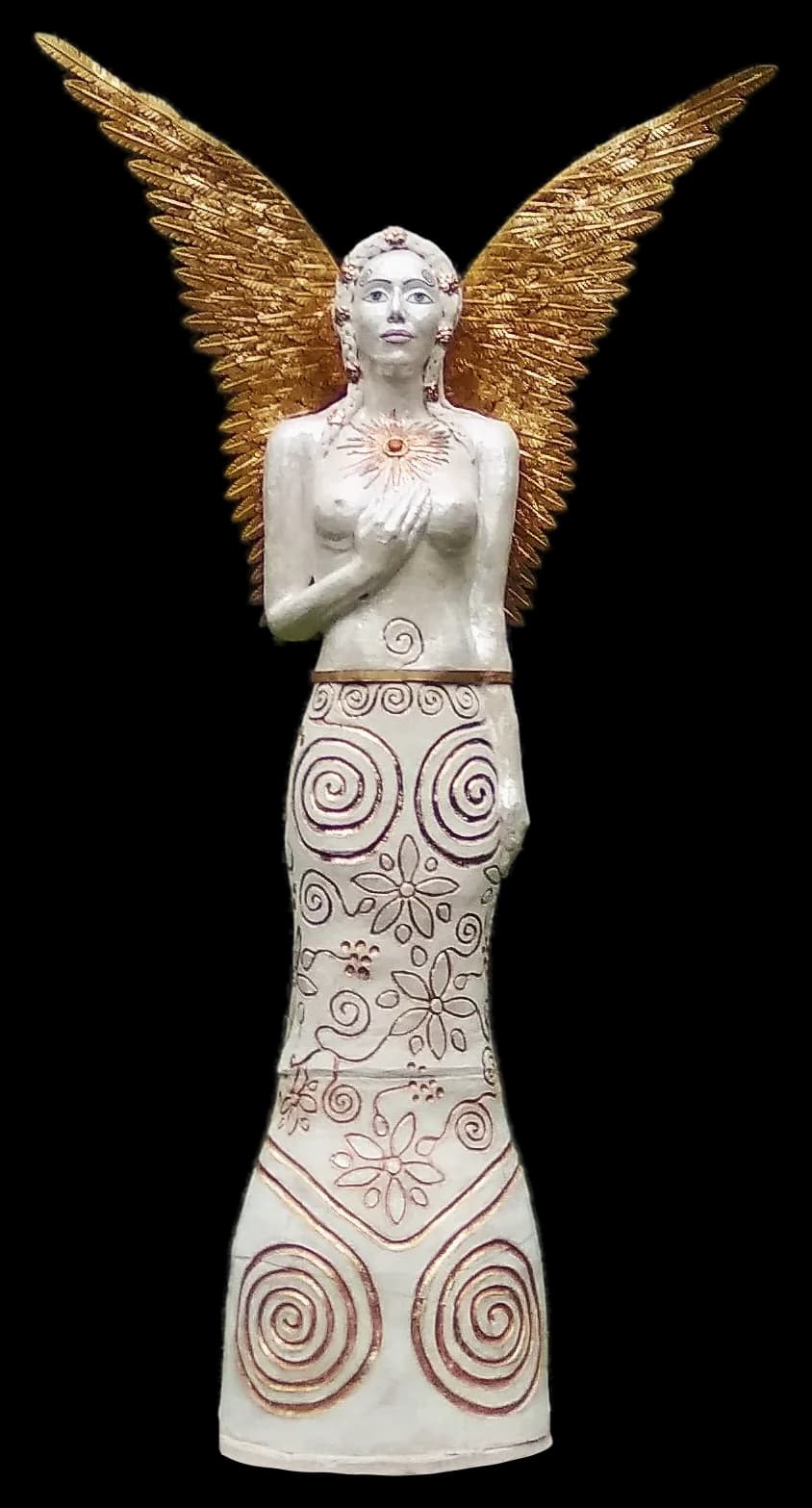
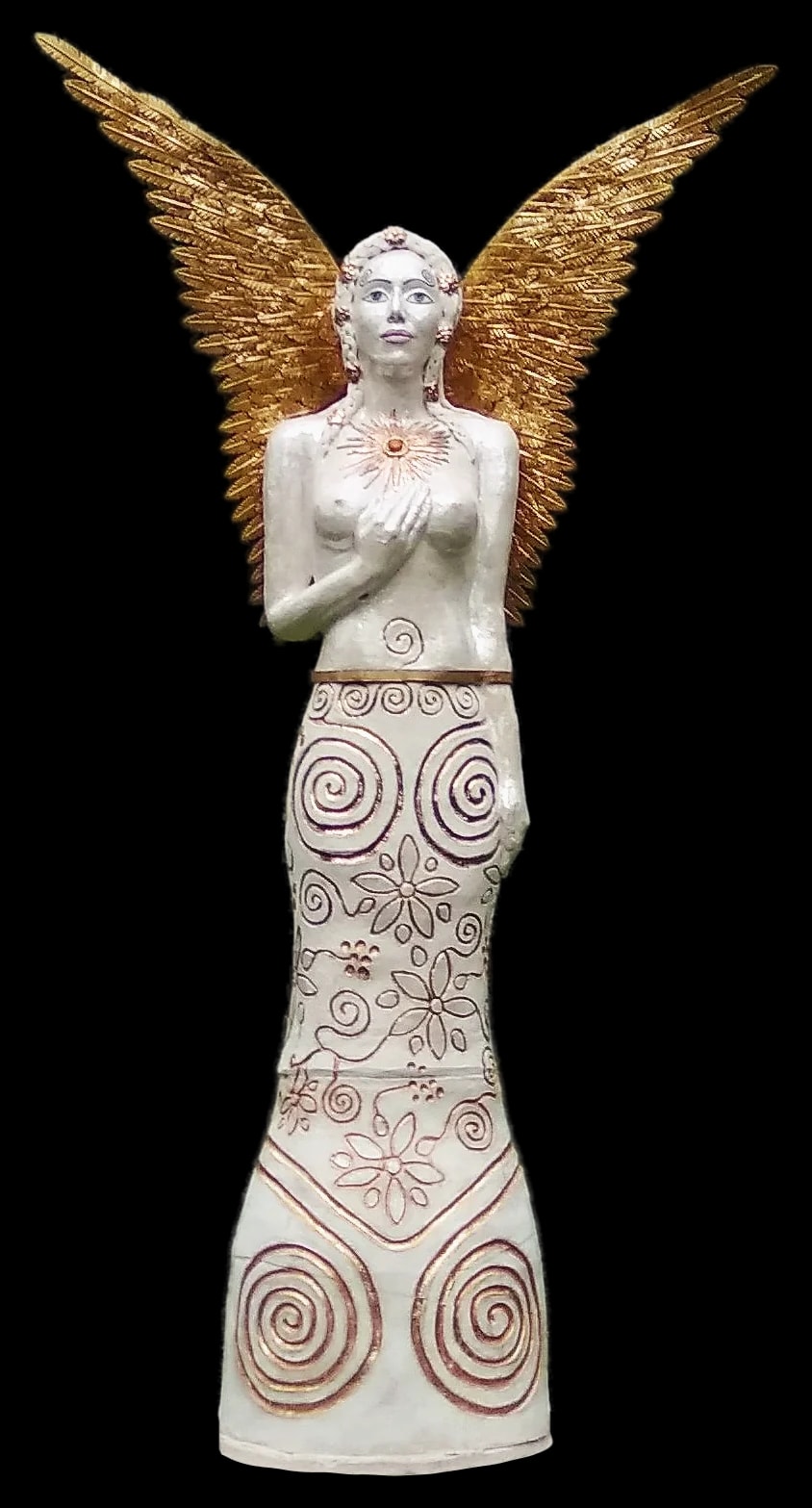
Freya II by RHEAsilvia is the white Freya with spirals. She is 180 centimetres tall, hand-built from clay in three parts and fired three times, a unique piece. Her sister Freya I carries a cat on her shoulder and wears a crown of rays: she is a separate sculpture, and her story is told in Freya I: The Goddess with Cat and Crown of Rays.
See the sculpture: Freya II
Frequently asked questions
What does the goddess Freya stand for?
For love, beauty and fertility, for prosperity and happiness. At the same time she is a goddess of war and death and the mistress of seiðr, the Norse magic of the seeress. In her, life and death are joined.
What animal belongs to Freya?
The cat. Two cats draw her chariot. The falcon belongs to her too: in her falcon cloak she flies through the worlds. She also rides Hildisvíni, the boar with golden bristles.
What is the difference between Freya and Freyja?
There is none. Freyja is the Old Norse form of the name, and Freya is the form most used today. Both names mean the same goddess.
Is Freya married to Odin?
No. Freya’s husband is Óðr, for whom she weeps tears of gold. Odin’s wife is Frigg. With Odin, Freya shares the fallen of the battle.
Are Freya II and Freya I the same sculpture?
No. Both are 180 cm tall and hand-built in three parts, but they are two separate works. Freya II is the white Freya with spirals, fired three times. Freya I carries a cat on her shoulder and wears a crown of rays; she was fired twice.