ARTEMIS, Greek goddess of the hunt, the forest, the wilderness, birth and the moon, guardian of women and children
In Greek mythology, Artemis is the goddess of the hunt, the forest, the wilderness, birth and the moon, and the guardian of women and children.
- Family: She is the daughter of Zeus and Leto and the twin sister of Apollo.
- Roman counterpart: In Roman mythology she corresponds to the goddess Diana.
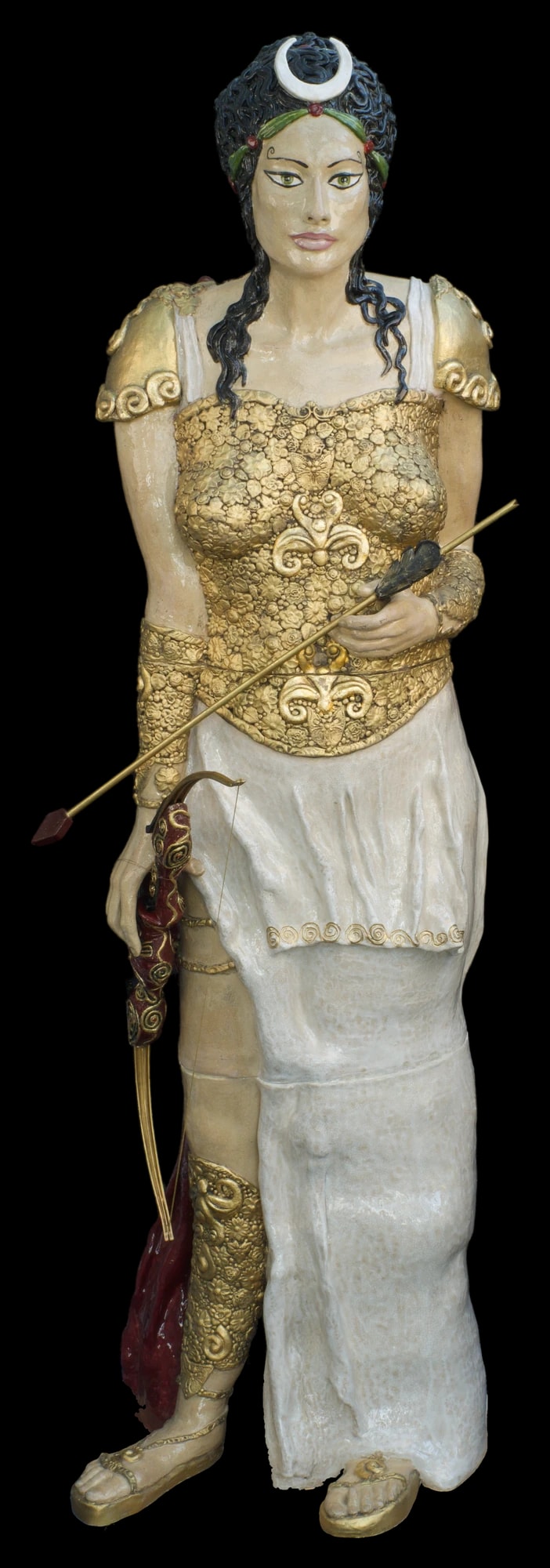
- Attributes: Arrow, bow, quiver, and often accompanied by animals such as deer or dogs.
- Qualities: She remained a virgin forever and embodies independence and strength, but she can also appear unyielding or vengeful when her boundaries or nature are violated.
The birth of Artemis
Leto gave birth to her children on the island of Delos. Artemis came into the world first, and at once she helped her mother bring her brother Apollo into the world. So the virgin goddess was a midwife from her very first day. Women call on her in the hour of birth, and she guards mothers and their children.
Artemis lives in the mountains, the forests and the meadows. With her companions, the nymphs, she roams the wild places, hunts and leads the round dances. The wild animals are hers: she hunts them, and she protects them.
Potnia Theron, the Lady of the Animals
Although she was known in classical Greece as the virgin Olympian goddess of the hunt with bow and arrow, her being draws on much older ideas from the Stone Age and the Bronze Age.
- Potnia Theron: In her oldest layer, Artemis is a prehistoric goddess of nature and of the wilderness. This role as Potnia Theron, the Lady of the Animals, is a direct inheritance from hunter-gatherer cultures, in which a mighty power decided the success of the hunt and at the same time protected the game.
- Pre-Greek and Anatolian influences: Her famous cult in Ephesus (the Artemis Ephesia) rests on an Anatolian mother and fertility goddess (related to Cybele). When the Greeks settled Asia Minor, they merged their own Artemis with this prehistoric, native Great Mother. The famous Ephesian statue with its many breasts symbolises this ancient fertility.
- The prehistoric bear cult: Her name may be related to the Indo-European word for bear (arktos). In her sanctuary at Brauron in Attica, young girls danced dressed as “she-bears”, a relic of shamanic, Stone Age rites of passage.
The she-bear
The bear belongs to Artemis. Callisto, one of her companions, was turned into a she-bear and set in the sky as the Great Bear. Every night she still circles the North Star.
On Crete a cave bears the name Arkoudiotissa, the cave of the she-bear, to this day. There the faithful honour the Panagia Arkoudiotissa, Mary of the she-bear. The old goddess of the wild lives on in the name of the Christian Mother of God.
From the wild mother to the huntress
The classical Artemis is the end product of an evolution over thousands of years: she began in the Stone Age as a wild, animal-shaped mother of protection and of the hunt, took on features of oriental and Anatolian fertility goddesses in the Bronze Age, and was only humanised in Greek antiquity into the familiar, athletic twin sister of Apollo.
Yet the old goddess is still present in the huntress. When Artemis carries her silver light through the night as goddess of the moon, and when she stands by women in childbirth, the wild mother of the beginning shows herself.
The Artemis sculpture
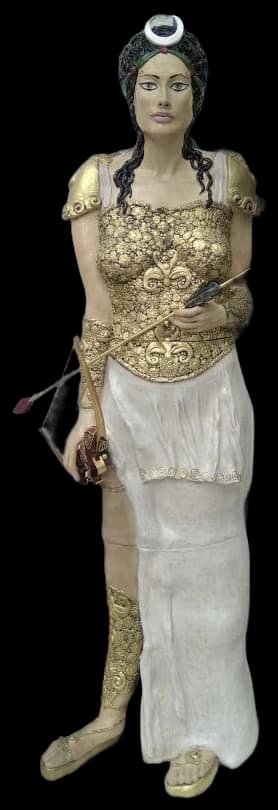
Artemis by RHEAsilvia is 175 centimetres tall, hand-built from clay in three parts and fired twice, a unique piece.
See the sculpture: Artemis
Frequently asked questions
What is Artemis the goddess of?
Of the hunt, the forest, the wilderness, birth and the moon. She is the guardian of women and children, and as Potnia Theron, the Lady of the Animals, she both hunts and protects the wild animals.
Which animals belong to Artemis?
Above all the deer and the dog, which accompany her on the hunt. The she-bear belongs to her from the oldest times: at Brauron girls danced for her as “she-bears”, and her companion Callisto shines in the sky as the Great Bear.
Are Artemis and Diana the same goddess?
Yes. Diana is the Roman name of Artemis. The Romans honoured in Diana the same goddess of the hunt, the forest and the moon.
Why does a virgin goddess protect births?
Because Artemis helped her mother Leto at the birth of her brother Apollo on her very first day. The virgin goddess is the one who belongs to no man and stands by all women, from girlhood to the hour of birth.