Lady of Avalon II: The Antler Crown
October 25, 2026
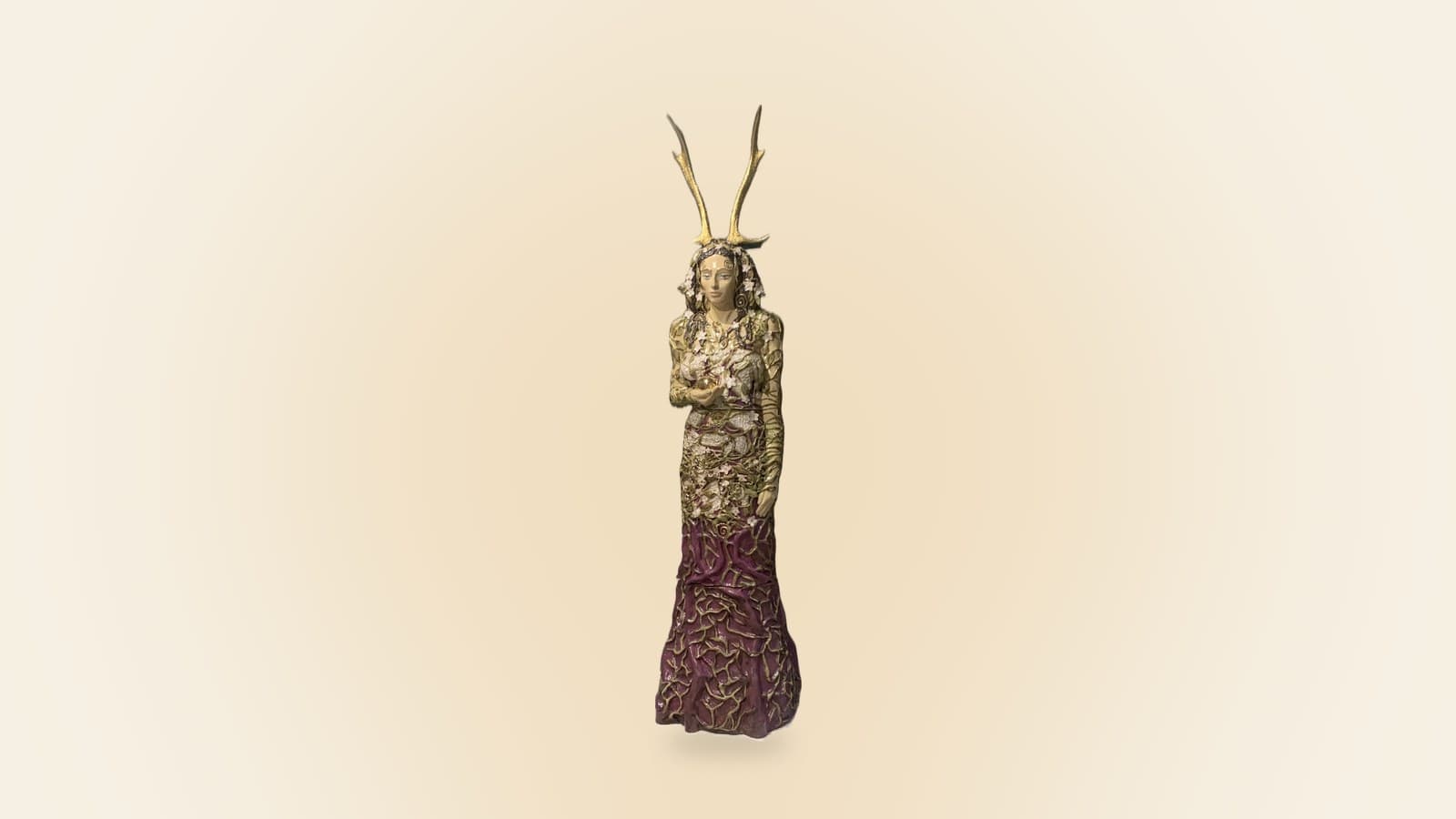
Avalon, the Isle of Apples, lies behind the mists of British legend: a place of healing, where nine sisters rule and the wounded Arthur was carried after his last battle. In this artistic interpretation, the Lady of Avalon is its keeper, the guardian of the threshold between the worlds.
Lady of Avalon II stands 225 centimetres tall with her antlers.
Lady of Avalon II and the antler crown
The antler crown gives this page its focus. A useful distinction is between a motif in a contemporary artwork and an attribute prescribed by an older text. Geoffrey’s Avalon passage describes the island’s rulers and Morgen’s abilities, but does not give them antlers. Here the crown belongs to the sculpture’s modern artistic language. It can be considered in relation to older images of human and animal forms without presenting Lady of Avalon II as a reconstruction of an ancient cult statue.
Deer antlers, renewal and horns
Antlers themselves suggest a particular kind of change. The British Deer Society explains that they are bone, growing under a covering called velvet and normally shed and regrown each year. That cycle offers a possible contemporary reading of the crown as renewal through loss. The biological observation does not establish what an ancient community believed, nor does it identify the sculpture’s intended meaning. It gives a viewer one grounded starting point for reflection, while leaving the artwork open to other responses.
The distinction between antlers and horns is therefore useful even in the language used for an artwork. The British Deer Society specifically cautions against confusing the two. Calling this motif an antler crown keeps the description close to the existing artist-approved wording. It also avoids treating every horned or antlered figure as part of one religion. A resemblance between head ornaments can prompt a comparison, but cannot by itself supply a shared divine name or a historical line of descent.
Star Carr antler headdresses
An archaeological comparison comes from Star Carr in North Yorkshire. Scarborough Museums describes a modified deer skull interpreted as a headdress: its interior was smoothed, its antlers reduced and holes made at the back. Proposed uses include hunting disguise and ritual activity. These are interpretations of a surviving object, rather than an inscription naming a deity. The worked skull shows that people materially transformed the animal head for another purpose; it does not identify that purpose beyond doubt.
A research team’s experimental study of a Star Carr headdress adds attention to making. The 2016 paper combines the examination of manufacturing traces with experimental replication and three-dimensional recording. Its authors argue for a shamanic interpretation, which should remain attributed to them. For a modern viewer, the comparison can raise a question about how wearing an animal form might change a person’s sense of identity. That question belongs to interpretation. The study does not link its prehistoric object to Avalon or to RHEAsilvia.
Cernunnos and antler imagery
Another comparison belongs to the study of Cernunnos. In his scholarly article on the Paris relief, Hugues Vertet discusses the surviving upper body and the antlers from which ornaments have been described as hanging. He examines disputed details of the head instead of assuming that every part of the image is immediately self-explanatory. The comparison matters here because it shows how closely an antlered image can require reading. An antler motif alone does not make the modern Lady identical with Cernunnos.
Avalon, archaeology and modern interpretation
These comparisons have different limits. A worked skull, a relief discussed by an archaeologist and a medieval poem do not answer the same question. One preserves traces of manufacture; another offers an image whose details are debated; Geoffrey supplies named literary figures and actions. Keeping those records apart makes it possible to notice affinities without manufacturing a continuous tradition. Lady of Avalon II can enter that conversation as a present-day artwork whose name and crown bring different points of reference together.
Frequently asked questions
How tall is Lady of Avalon II?
225 cm with her antlers, built in three parts.
How is Lady of Avalon II different from Lady of Avalon I?
They are two separate works. Lady of Avalon I, 180 cm with antlers, was made for the Goddess Temple in Glastonbury. Lady of Avalon II is the larger one, 225 cm with antlers.
Does Geoffrey describe an antler-crowned Lady of Avalon?
Not in the Vita Merlini passage examined here. It names Morgen and describes her abilities, but gives her no antler crown. The antlers of Lady of Avalon II belong to its modern artistic interpretation. That distinction leaves room for the work to respond freely to the legend.
Do the Star Carr headdresses prove an ancient Lady of Avalon cult?
No such connection is established by the cited museum account or research paper. They examine modified deer skulls, their manufacture and possible uses. Hunting disguise and ritual readings concern those objects. Transferring the name Lady of Avalon to them would add an identification the evidence does not provide.
Does the crown mean Lady of Avalon II is Cernunnos?
A shared motif is insufficient for that identification. Vertet’s article concerns the Paris image of Cernunnos and disputed details of its head. Lady of Avalon II is the separate contemporary work named by the artist. Comparison can illuminate the motif without merging the figures.
See the sculpture: Lady of Avalon II
Sources
- Geoffrey of Monmouth, Vita Merlini (c. 1150), lines 908–940 with English translation (Camelot Project, University of Rochester)
- Geoffrey of Monmouth, Historia Regum Britanniae (c. 1136), excerpts: Caliburn made in the Isle of Avalon (Camelot Project)
- Avalon: Geoffrey’s Historia Regum Britanniae, Glastonbury and the name (Wikipedia)
- Glastonbury Goddess Temple, our story
- Sculpture facts: atelier RHEAsilvia
- Charles Smith-Jones, British Deer Society, Antlers Not Horns, 22 March 2023: antler growth, bone and annual replacement
- Scarborough Museums and Galleries, Antler Headdress, Star Carr object description and proposed uses
- Aimée Little and colleagues, Technological Analysis of the World’s Earliest Shamanic Costume: A Multi-Scalar, Experimental Study of a Red Deer Headdress from the Early Holocene Site of Star Carr, North Yorkshire, UK, PLOS ONE 11(4), 2016, e0152136
- Hugues Vertet, Observations sur le dieu « Cernunnos » de l’autel de Paris, Bulletin de la Société nationale des Antiquaires de France, 1985 volume, published 1987, pages 163 to 177, especially page 165