Freya II: Cats and the Crown of Rays
October 25, 2026
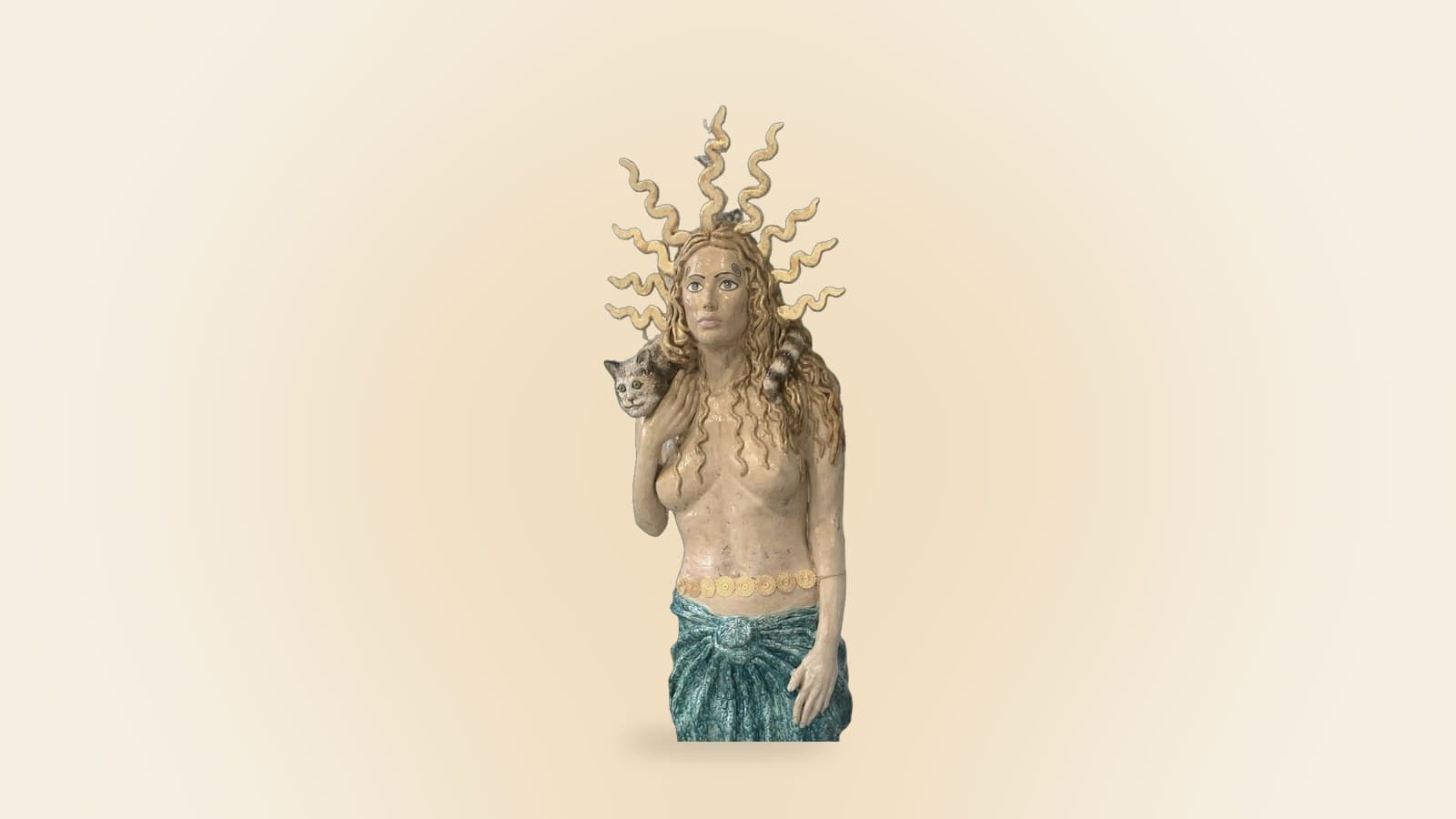
In Snorri Sturluson’s Prose Edda, Freyja is the most famous of the goddesses, and when she goes abroad, she drives in a chariot drawn by two cats. In this artistic interpretation, the cat on the shoulder of Freya II recalls those cats, the companions of the goddess.
Freya II stands 180 centimetres tall, with a cat on her shoulder and a crown of rays.
Freya’s cats in the Prose Edda
The shoulder cat brings one small detail of Snorri’s description into the foreground. Gylfaginning says that two cats draw Freyja’s chariot when she travels. It does not give them names, describe their colour or identify a breed. That silence leaves considerable freedom for a contemporary artist. It also gives a useful limit to interpretation: an animal can recall the Eddic passage without being a zoological reconstruction of it. Freya II makes the cat part of a close encounter with the goddess rather than a complete illustration of a journey. This last comparison is a modern editorial reading of the existing motif.
The cats appear again in the account of Baldr’s funeral. Among the arriving gods, Snorri distinguishes their means of travel: Freyr comes with his boar-drawn chariot, Heimdall with his horse, and Freyja with her cats. The animal association therefore belongs to a solemn gathering as well as to her general description. In a modern reading, this prevents the cat from being only a decorative sign of gentleness. The same textual association accompanies a goddess who participates in the divine community’s mourning. The passage does not say that the cats themselves have a special funerary function.
Cats and Gleipnir in Norse mythology
Elsewhere in Gylfaginning, a cat supplies something impossible to the making of Gleipnir, the slender binding made for the wolf Fenrir. Its ingredients include the sound of a cat’s footfall, alongside a woman’s beard and the roots of a mountain. Snorri explains the joke through their absence: these are things his listener cannot find. This is a separate story, not a tale about Freyja’s animals. Read comparatively today, it shows how a familiar cat could enter an extraordinary myth through the very quality of moving almost unheard. It does not establish silent movement as the historical meaning of Freya II’s cat.
Freya’s cats and archaeological evidence
The distinction between a literary attribute and an archaeological identification is equally important. Snorri supplies a clear written association between Freyja and cats. That does not mean every old female figure beside an animal can be securely named Freyja. For this sculpture the name is already supplied by the artist, so no such identification is required. A modern viewer can begin with the named goddess and the attested animal motif, while leaving the many unanswered details of the medieval passage open. There is no need to supply an invented cat-name or a lost ritual to make the connection meaningful.
Freya II’s crown of rays and Sól
The crown of rays belongs to a different level of meaning. It is part of the artist’s description of Freya II. Snorri’s accounts of Freyja’s cats and other attributes do not prescribe such a crown. In a modern editorial interpretation, rays can suggest radiance, presence or an outward movement of energy. Those associations describe a possible response to the sculpture. They should not turn Freyja into the Eddic sun goddess: Gylfaginning tells the story of Sól separately, assigning her the task of driving the sun’s horses.
A comparison from another tradition helps explain why rays can suggest sunlight so readily. Peterborough Museum’s guide to Roman coins describes the radiate crown as pointed forms representing the sun’s rays and associates it with the Roman god Sol. Roman Sol and Norse Sól belong to different traditions, and this Roman example establishes no line of descent for Freya II’s crown. It is a visual comparison only. Contemporary goddess art can bring together a specifically attested animal and a more freely interpreted form of radiance without claiming that both originated in the same medieval description.
Freya’s cats in later art
Later art shows how readily the cat motif could be reworked. Nationalmuseum’s Freja Seeking her Husband by Nils Blommér, dated through its inscription to 1852, includes the two-cat vehicle. The museum also points to a Madonna-like treatment of Freyja. This is a documented nineteenth-century reception of the goddess, not evidence of Viking-period pictorial conventions. Set beside the shoulder cat, it offers a comparison of artistic choices across time, without implying that RHEAsilvia used Blommér as a model.
Frequently asked questions
How tall is Freya II?
180 cm, built in three parts.
How is Freya II different from Freya I?
They are two separate works of the same height, 180 cm. Freya II carries a cat on her shoulder and wears a crown of rays; she was fired twice. Freya I is the white figure with spirals, fired three times.
Do Freyja’s cats have names in the Edda?
Not in the passages used here. Gylfaginning mentions the pair drawing her chariot and brings them back at Baldr’s funeral, without naming them. A modern name can belong to a later retelling, but should not be presented as Snorri’s testimony.
See the sculpture: Freya II
Sources
- Snorri Sturluson, Prose Edda: Gylfaginning, § 24, tr. R. B. Anderson, 1901 edition (Project Gutenberg)
- Sculpture facts: atelier RHEAsilvia
- Nationalmuseum, Nils Blommér, Freja Seeking her Husband, 1852: collection record and commentary on the cat-drawn vehicle
- Peterborough Museum and Art Gallery, Coins (Roman), learning resource, eighth PDF page: the radiate crown as solar imagery