Noreia: Goddess of Noricum and Her Sources
October 25, 2026
Noreia reaches us most clearly through people who addressed her by name. A votive altar from Hohenstein, published by the kärnten.museum, begins with a dedication to Isis Noreia and records a vow fulfilled for the welfare of several men connected with iron administration. This is evidence of worship, rather than an episode from a surviving divine biography. It gives the goddess a place in the working and religious relationships of Roman Noricum. Starting with the inscription allows a different kind of encounter from the familiar retelling of a goddess’s birth, marriage or adventures.
Noreia, Noricum and the ancient town
Her name belongs beside Noricum and the ancient town called Noreia, but a neat translation should not replace the evidence. Marjeta Šašel Kos’s study Noreia: an Unsolved Enigma stresses the difficulties surrounding the town’s location. Strabo’s Geography, book 5, chapter 1, section 8, mentions Noreia near the place of Carbo’s clash with the Cimbri and describes gold washing and iron working in the region. He is speaking about a place. His passage does not explain the goddess’s name or establish whether a town was named for a goddess or the reverse.
The Hohenstein altar and iron administration
The Hohenstein altar’s Latin text is especially rewarding when read slowly. Its opening, Isidi Norei(ae), names the recipient. The expanded formula v(otum) s(olvit) l(ibens) m(erito) records fulfilment of a vow willingly and deservedly. Pro salute identifies the welfare of named people as the concern. These small phrases distinguish recipient, religious action and beneficiaries. They do not tell us the original occasion of the promise or describe a healing miracle. Protection is requested through an act that the stone commemorates, while the event behind that act remains unspecified.
The names preserve a social connection as well as a devotional one. Quintus Septueius Valens is the dedicator; Quintus Septueius Clemens, Tiberius Claudius Heracla and Gnaeus Octavius Secundus are named as beneficiaries. The inscription associates them with the iron enterprises of Noricum, Pannonia and Dalmatia through the titles conductor and procurator. It therefore supports a connection between this dedication and iron administration. Reading it does not require inventing miners’ ceremonies or attributing a particular tool to the goddess. The human network is already substantial evidence, even without an accompanying myth.
There is also a distinction between the people named and the people who might have stood before the altar. The inscription records certain men, their offices and a vow; it is not a complete attendance list for the sanctuary. An editorial reading can recognise the importance of institutional relationships without assuming that these exhaust every experience of worship. This care matters when the surviving names become the basis for a goddess’s modern identity. The altar lets us say that these individuals honoured Isis Noreia. It does not let us reconstruct every worshipper’s language, ancestry or private understanding.
Isis Noreia and the origins of her cult
The combined name Isis Noreia is therefore central, but its implications should remain precise. Peter Scherrer’s archaeological account places the Hohenstein sanctuary near Pulst in Carinthia’s Glan Valley and discusses its Roman building history. He proposes that Noreia may have developed as a Roman provincial personification, rather than simply continuing an ancient mother goddess. This is a scholarly argument, not an additional sentence on the altar. Keeping the proposal visible preserves the difference between an attested divine name and an interpretation of why that name came to matter under Roman rule.
The disagreement has not disappeared. In a review of Csaba Szabó’s Roman Religion in the Danubian Provinces, Tünde Vágási questions an overly general provincial reading and points to the local concentration of evidence around Virunum and Celeia. Together these discussions make a useful caution: calling Noreia a goddess of Noricum identifies a historical setting, but does not settle the scale or origins of her cult. A modern account should show that debate rather than silently turn one reconstruction into an ancient self-description.
Noreia, Fortuna and ancient statues
Her reception in art is bound up with the naming of ancient images. Hedwig Kenner’s 1963 Treccani entry identifies a marble figure from Virunum with Noreia and discusses Fortuna-like imagery. Scherrer’s separate study of divine images calls that identification highly uncertain and favours a connection with the city’s Fortuna. The important point for a visitor is the disagreement itself. A statue can be ancient while its label remains a modern attribution. It should not become a secure portrait of Noreia merely because the identification has been repeated in accounts of regional art.
Noreia sanctuaries and the evidence
A similar caution applies to sanctuaries. The ArchaeoRegion account of Frauenberg explains that an earlier interpretation associated its podium temple with Isis and considered a link with Noreia. Its discussion treats the cultic evidence more cautiously. This means that a map of places once connected with the goddess cannot simply be copied as a map of confirmed Noreia temples. The history of discovery and reassessment belongs to her modern reception. It also gives readers a practical way to evaluate claims: ask whether a name is actually inscribed or has been supplied through comparison.
Noreia’s symbols and the two spheres
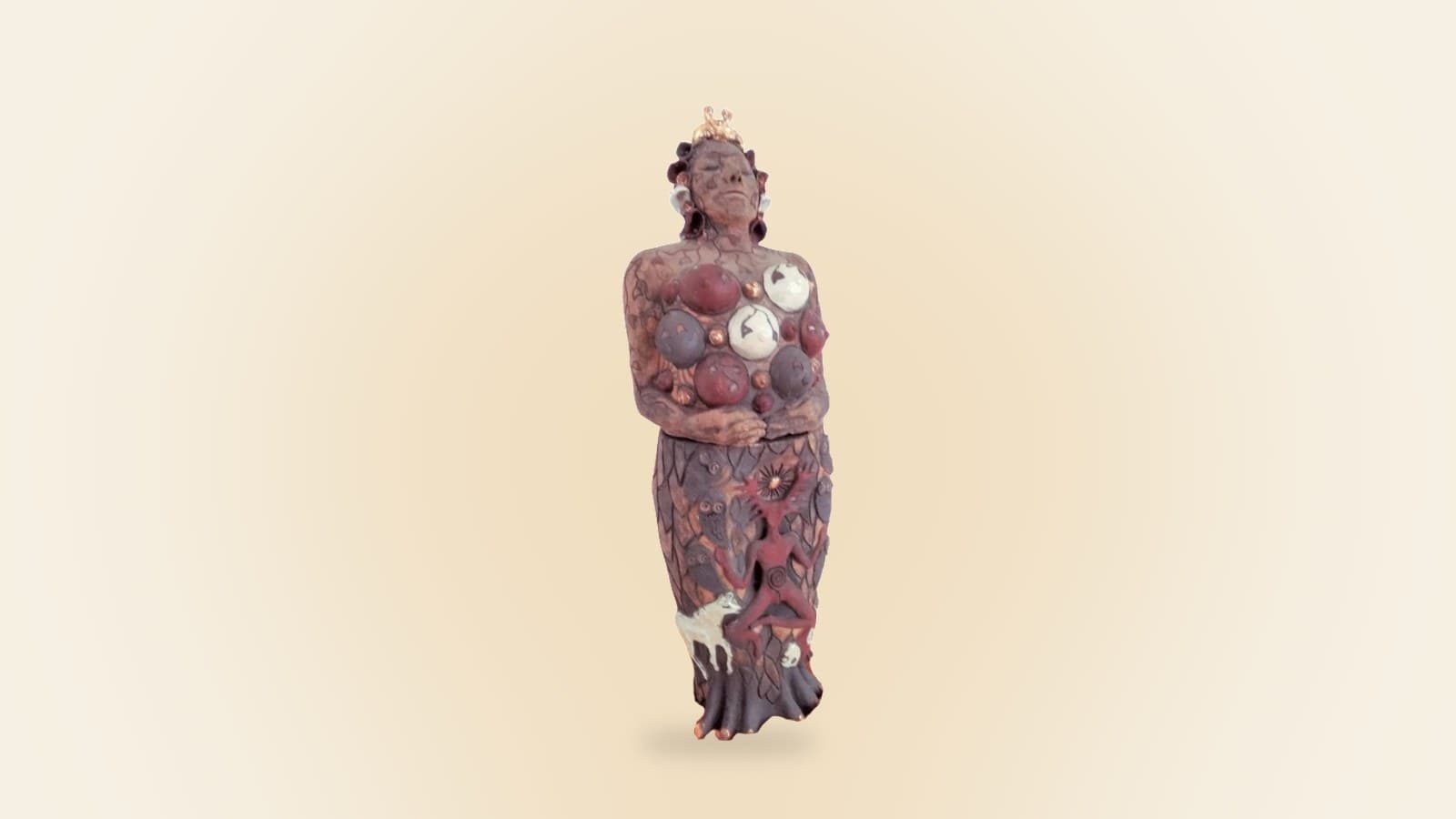
Symbols need the same attention. Kenner discusses a globe associated with an altar and several proposed identifications, but that older reconstruction does not establish two spheres as a universal ancient attribute of Noreia. For the contemporary sculpture, the secure information comes from the atelier catalogue, which describes a monumental figure holding two spheres. This page leaves their meaning open. A viewer may consider balance, relationship or the act of holding as modern responses to that description. None of those readings supplies a missing ancient ritual or an undocumented explanation from the artist.
Frequently asked questions
Who was Noreia?
Noreia was a goddess worshipped in Roman Noricum, attested by dedications including the Hohenstein altar to Isis Noreia. Her precise origins and the extent of her role remain debated. The surviving inscription is firmer evidence than a reconstructed personal mythology or a confidently assigned ancient portrait.
Is Noreia the same as Isis?
The Hohenstein inscription combines the names in an address to Isis Noreia. That is direct evidence for a connection in this dedication. It does not show that every aspect of the Egyptian goddess’s mythology was transferred to Noreia, or that all worshippers understood the relationship identically.
What connects Noreia with iron?
The altar names a dedicator and beneficiaries associated with iron administration. This anchors the connection in a specific act of devotion and a particular professional network. It does not supply a surviving story of Noreia discovering metal, nor does it document ceremonies performed by every worker in the mines.
Where was the town of Noreia?
Its location remains a scholarly problem, explored by Šašel Kos. Strabo mentions the town in a geographical passage about the Alpine region and Carbo’s encounter with the Cimbri. That text should not be confused with evidence locating a particular temple or explaining the origin of the divine name.
See the sculpture: Noreia
Sources
- kärnten.museum, Hohenstein votive altar, Lap. 104, LUPA 5764: Latin inscription and museum commentary
- Strabo, Geography 5.1.8, translated by H. L. Jones, LacusCurtius: the town Noreia, Carbo and metalworking
- Marjeta Šašel Kos, Noreia: an Unsolved Enigma, Arheo 27, 2010, pp. 81–90, English summary p. 87
- Peter Scherrer, Cults and Sanctuaries in Noricum, RGZM research project: Hohenstein and debated provincial personification
- Tünde Vágási, review of Csaba Szabó, Roman Religion in the Danubian Provinces, Historical Studies on Central Europe 3.2, 2023, pp. 211–219
- Hedwig Kenner, Noreia, Enciclopedia dell’Arte Antica, 1963, Treccani: historical image identifications, treated here as disputed
- Peter Scherrer, Das Bild einheimischer Gottheiten in Noricum, RGZM: disputed identification of the Virunum statue
- ArchaeoRegion Südweststeiermark, Site Frauenberg: archaeological evidence and earlier Isis/Noreia attribution
- Sculpture facts: atelier RHEAsilvia