Mari: Basque Mountain Lady and Serpent Myths
October 25, 2026
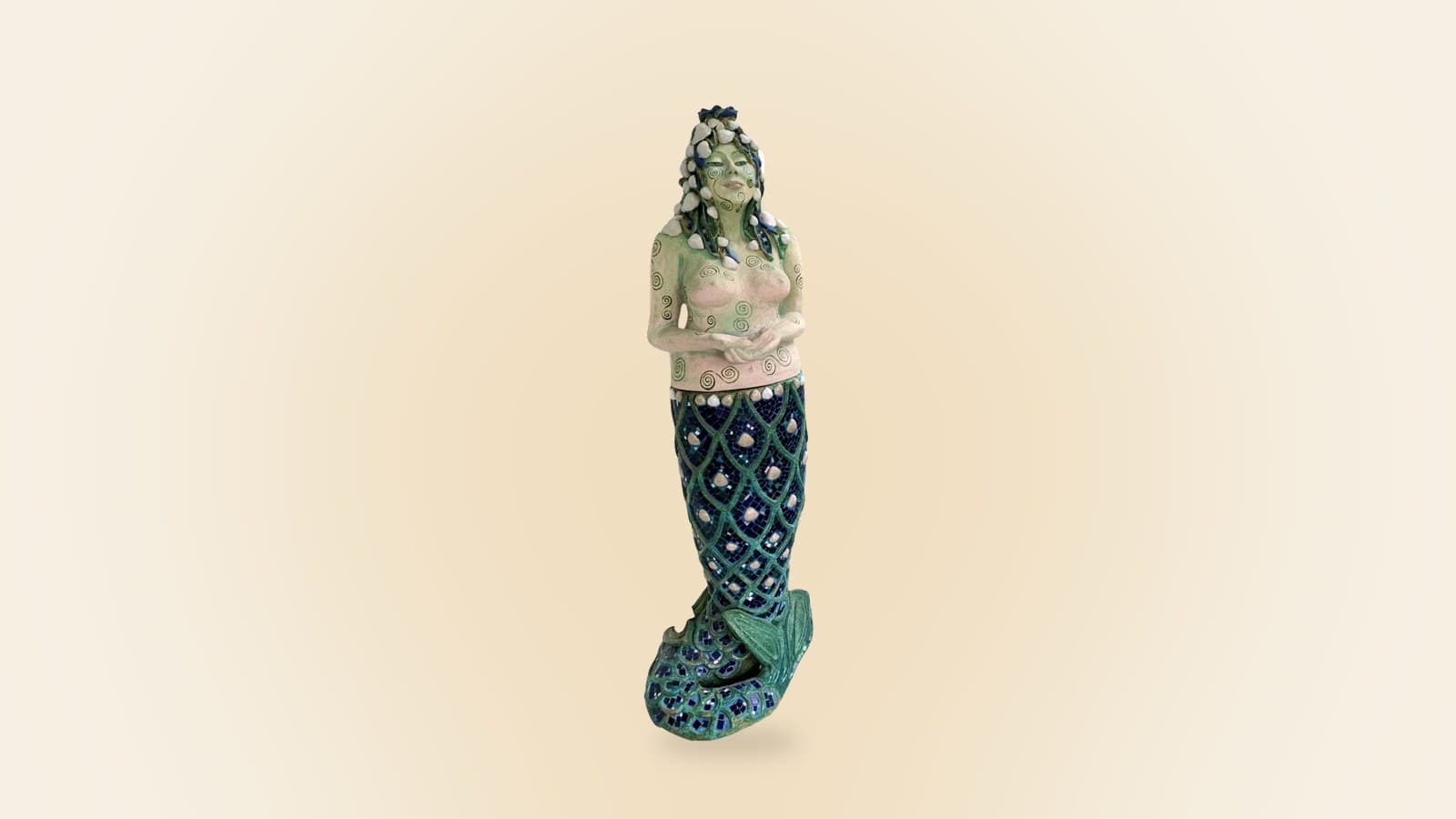
Mari belongs to the Basque traditions of mountain ladies, caves and unsettled weather. In the accounts assembled around her name, a woman may inhabit a cavern, appear in fire or move between mountains. José Miguel de Barandiarán gathered such local narratives in Mari, o el genio de las montañas. Reading that collection means listening to several places and narrators. The resulting figure has many appearances and histories. RHEAsilvia’s Mari enters this tradition as a modern ceramic interpretation, with a serpent tail that invites a closer look at the distinction between Mari and her serpent-associated companion.
Mari’s name and the Lady of Anboto
Names preserve the local character of these stories. Barandiarán records titles associated with Anboto, Aketegi, Muru and Txindoki, including forms he translates as Lady or Witch. On the following page he explains that he uses Mari because it appears widely distributed, while admitting that he does not know what earlier generations called the being. That admission matters more than a confident translation of the name would. The collection gives us a working name for related accounts; it does not recover an original divine name from antiquity.
The etymology needs similar care. In Mitos vascos para pensar, the anthropologist Anuntxi Arana questions the tendency to make Mari a universal name and to merge it with similar-sounding names such as mairi, maide and maindi. She stresses the prominence of titles meaning Lady of Anboto or Lady of Murumendi in local testimony. Consequently, this page leaves Mari without a fixed ancient translation. Similar spelling cannot establish shared identity, and translating an accompanying title as Lady does not prove that Mari itself originally meant Lady.
Mari’s caves, transformations and storms
The places are unusually concrete. Barandiarán lists mountain and cave dwellings, then records an Orozko account told by Juan Manuel de Ugáriza in 1922. In that version, a mother’s curse sends the young woman into the air, and she subsequently alternates seven years in Supelaur with seven in Anboto. The narrative supplies its own explanation for movement between dwellings. It is one named teller’s version, not a calendar to impose on every Mari story. The place, date and attribution let readers keep its particular voice in view.
Other narratives make ordinary gestures uncanny. In the collection’s section on transformations, a beautiful woman combs her hair on a stone near Elosua. She refuses a priest’s expected greeting, announces damage to the harvest and departs in flames; a storm follows. Barandiarán attributes the telling to Claudio de Orbea in 1921. Here beauty, combing and fire belong to a sequence of encounter and consequence. They are narrative details, rather than a compulsory set of accessories that every representation of Mari must include.
The cave’s riches also change with the telling. Barandiarán contrasts coal that becomes gold outside a cavern with apparently golden objects that become rotten sticks when removed. These reversals make a boundary between the human world and the cave perceptible. As a modern literary reading, the interest lies in uncertain value: something humble can become precious, while apparent wealth can dissolve. This interpretation follows the contrasting stories without turning them into a promise of prosperity or treating every object described in a legend as Mari’s permanent emblem.
Mari, Sugaar and serpent stories
Serpents require an especially careful distinction. Auñamendi’s Sugaar entry identifies a male serpent as Mari’s companion and allows him human, serpent and fiery forms. Its separate collection of textual extracts quotes Barandiarán on Maju in Azkoitia, where he is called Mari’s husband. Their Friday meetings bring a violent storm; a Zarautz variant describes him visiting to comb her hair. These are locally attributed relationships and episodes. They establish a serpent association within Mari’s narrative circle, but do not make a serpent tail her obligatory bodily form.
A further serpent story belongs to Sugoi. In Barandiarán’s account reproduced by Auñamendi, two brothers encounter him in Balzola cave. One injures his tail, while the other objects to that cruelty. Later, a mysterious man helps the compassionate brother return home and gives him gold and a red belt for the other brother. When the belt is fastened around a tree, the tree burns. The story gives serpent imagery a moral and narrative setting. It also shows why identities should remain attached to their particular accounts rather than collapse into a single creature.
Arana offers another way to think about the connection. Her comparative discussion places the mountain lady beside dragon traditions and the medieval story of Melusine, a woman who becomes a serpent. She explores whether the lady and dragon express a unity of contrasting powers. That is an anthropological interpretation, not an eyewitness description of Mari’s anatomy. It can enrich a modern encounter with a serpent-tailed sculpture, provided the comparison remains visible as a comparison. Neither Melusine’s story nor Sugaar’s serpent form supplies a universal portrait of Mari.
Mari as Mother Earth
The broader earth-goddess reading also has a history. Juan Inazio Hartsuaga’s Auñamendi overview describes Mari through the earth and natural forces, while explicitly crediting Barandiarán with the hypothesis of her symbolic identity as Mother Earth. The older Auñamendi overview also records rules of conduct and punishment of lying, theft and broken promises. Together these accounts extend the subject beyond a beautiful mountain apparition. They invite attention to dependence, exchange and accountability, while the claim of a single underlying earth divinity remains an interpretation of the collected traditions.
Mari in modern sculpture
Mari has a documented place in modern sculpture beyond this atelier. The Bilbao Fine Arts Museum records Néstor Basterretxea’s Mari, dated 1975, in oak. Its collection entry connects the subject with Anboto and the imaginative importance of the cave in Basque art. This offers a specific example of artistic reception rather than evidence for an ancient standard image. Comparing modern works can therefore begin with their shared subject while leaving each artist’s formal decisions distinct. A recorded sculpture is evidence of a modern response to tradition, with its own date and material.
Frequently asked questions
Who is Mari in Basque mythology?
Mari is the name used by Barandiarán to gather related traditions of a female mountain being, often called the Lady of a particular place. Her stories concern caves, transformations and weather. Interpreting her as Mother Earth is a scholarly reading of that material, identified as such in Auñamendi.
Does Mari have a serpent tail in the sources?
The sources discussed here do not establish a serpent tail as her fixed form. Sugaar is explicitly serpent-associated and connected with Mari. Arana also explores lady-and-dragon comparisons. The tail in RHEAsilvia’s sculpture belongs to its modern artistic interpretation.
Are Mari and Sugaar the same figure?
Auñamendi presents Sugaar as Mari’s companion, and its quoted local accounts call Maju her husband. Those narratives distinguish the two. Arana’s exploration of an underlying unity between lady and dragon is a comparative interpretation and should be read at that different level.
What does the name Mari mean?
Its original meaning is not established by the sources used here. Barandiarán acknowledges uncertainty about the older name. Arana cautions against merging similar-sounding supernatural names. Titles translated as Lady describe how a figure is addressed without settling the etymology of Mari.
What are the confirmed facts about the Mari sculpture?
The atelier describes Mari as a monumental figure with a serpent tail. It is ceramic, stands 145 centimetres tall, consists of two parts and was fired twice. These are facts about the modern work; they do not establish dimensions, construction or bodily features for a historical cult image.
See the sculpture: Mari
Sources
- José Miguel de Barandiarán, Mari, o el genio de las montañas (1923), sections I to IV; University of the Basque Country scan
- Juan Inazio Hartsuaga, Mari, Auñamendi overview
- Auñamendi, Mari, 2002 overview: forms, dwellings and conduct
- Anuntxi Arana, Mitos vascos para pensar, chapters I and IX
- Juan Inazio Hartsuaga, Sugaar, Auñamendi overview
- Auñamendi, Sugaar: Textos, quotations from Barandiarán
- José Miguel de Barandiarán, Sugoi, Auñamendi
- Bilbao Fine Arts Museum, Néstor Basterretxea, Mari (1975), collection record
- Sculpture facts: atelier RHEAsilvia