Cernunnos: The Antlered God of the Gundestrup Cauldron
October 25, 2026
CERNUNNOS, Celtic god of nature, of the animals and of fertility
The Celtic form of the horned god, who was shown in sacred images with antlers attached to his head, while he sits in the lotus position like a yogi.
The horned god as partner of the goddess
For Barbara Walker, Cernunnos (often called simply the "Horned God") is the archetypal god of nature, the lord of the animals and of fertility. In pre-Christian cultures shaped by matrilineal descent he did not compete with the Great Goddess, but was her consort and partner: the male principle that embodied the eternal cycle of conception, death and rebirth in nature. His stag antlers symbolised the renewing power of nature, because they are shed every year and grow again.
As the antlers grow anew each spring, nature awakens anew each year. The god who wears them stands at the side of the goddess, who gives life, takes it back and renews it.
The demonisation by Christianity
A central point in Walker's encyclopedia is the reconstruction of how pagan symbols were turned upside down by patriarchy. Walker shows that the Christian church deliberately used the image of Cernunnos (and of related deities such as the Greek Pan) to create the visual image of the devil.
- The intention: The deep bond of the rural people with the old nature religions and with sexuality was to be broken.
- The result: Goat hooves, horns and the primal sexual force, in paganism symbols of life and protection, were turned in Christian dogma into attributes of evil and of sin.
Cernunnos on the Gundestrup cauldron
The Gundestrup cauldron is a magnificent, richly decorated silver vessel from the late La Tène period (about the 2nd to the 1st century BC). It was found in 1891 in a peat bog in Himmerland in Denmark (Rævemose near Gundestrup) and is today on display in the National Museum of Denmark in Copenhagen.
On one of the inner plates of the cauldron is the most famous image of Cernunnos ("the Horned One"), the Celtic god of nature, of the animals and of fertility.
- Appearance: Cernunnos is shown as a seated figure (in a kind of cross-legged or "yogi" posture) with majestic stag antlers on his head.
- Attributes: In his right hand he holds a torc (a Celtic neck ring), while his left hand grasps a ram-headed, horned serpent.
- Company: He is surrounded by animals (among them stags and dogs), which shows him as lord and protector of the world of animals and of nature.
Mystery and origin of the cauldron
- A meeting of cultures: Although the cauldron was found buried in Denmark, it was probably not made there. The silversmithing technique and certain elements of style point strongly to the Thracian metalwork of the Balkans, while the imagery and the figures clearly belong to Celtic mythology (or were made by Thracian craftsmen on behalf of Celts).
- Mythological meaning: The cauldron consists of a base plate, five inner and seven outer plates. Besides Cernunnos, the reliefs show warriors making offerings, the sacrifice of a bull, marching columns of soldiers and a scene in which warriors are dipped into a cauldron, which is often read as a Celtic rite of revival or of passage into the Otherworld.
The horned god in the wheel of the year
Cernunnos is the lord of the forest. He lives where the deer move through the trees, where the wild boar roots in the leaves and where the springs rise from the moss. He is the wildness of nature and her gentle care at the same time.
His life follows the wheel of the year. At the winter solstice, in the longest night, the goddess gives birth to the light, and the young god is born with it. In spring his antlers grow, and he grows with the green of the woods. At Beltane, when the meadows blossom, he unites with the goddess, and from their union comes the fertility of the land. In autumn, when the stags call in the forests, his strength is at its height. Then the year turns towards the dark, and he returns into the womb of the goddess, so that he can be born again.
So the horned god is never lost. Like his antlers, which fall and grow again, he goes and comes back, year after year, at the side of the goddess.
The Cernunnos sculpture
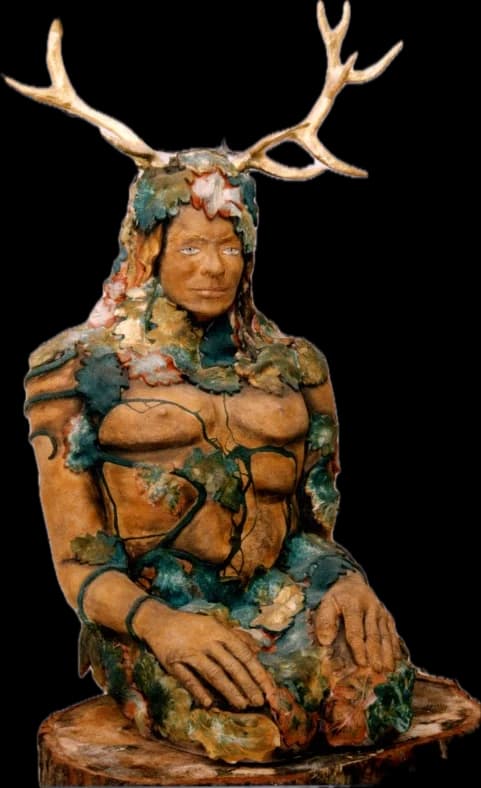
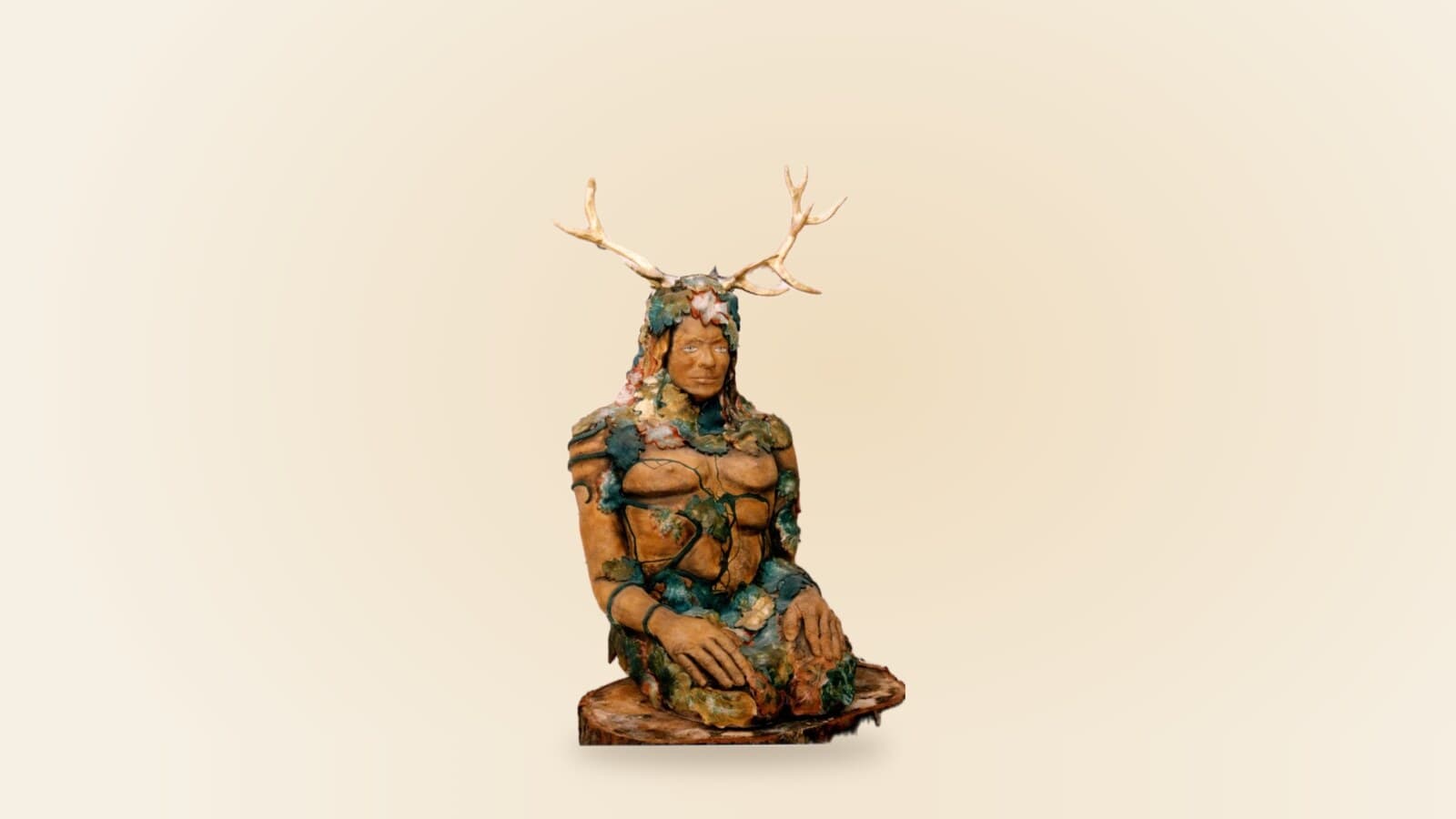
RHEAsilvia has formed Cernunnos as a hand-built ceramic sculpture: 110 cm high including the antlers, built in one piece and fired twice. The sculpture is unique.
See the sculpture: Cernunnos
Frequently asked questions
Who is Cernunnos?
Cernunnos is the Celtic god of nature, of the animals and of fertility. He is the horned god with the stag antlers and the partner of the Great Goddess in the eternal cycle of life, death and rebirth.
What does the name Cernunnos mean?
Cernunnos means "the Horned One". His antlers are shed every year and grow again, a sign of the renewing power of nature.
What do the images on the Gundestrup cauldron tell?
On one inner plate Cernunnos sits with stag antlers in the lotus position. He holds a torc and a horned serpent and is surrounded by stags and dogs. Other plates show offerings and warriors who are dipped into a cauldron of rebirth.
Why does Cernunnos wear antlers?
In those times the male god in the Mediterranean mostly wore bull horns, and in the Celtic lands the stag antlers. A remnant of this is the god Pan among the Olympians.
How does Cernunnos live in the wheel of the year?
He is born with the new light at the winter solstice, unites with the goddess at Beltane and returns into her womb when the year turns to the dark. Like his antlers, he always comes back.
Inspiration
- Barbara G. Walker: The Woman's Encyclopedia of Myths and Secrets (German: Das geheime Wissen der Frauen)