Blodeuwedd: Flowers, Betrayal and the Owl
October 25, 2026
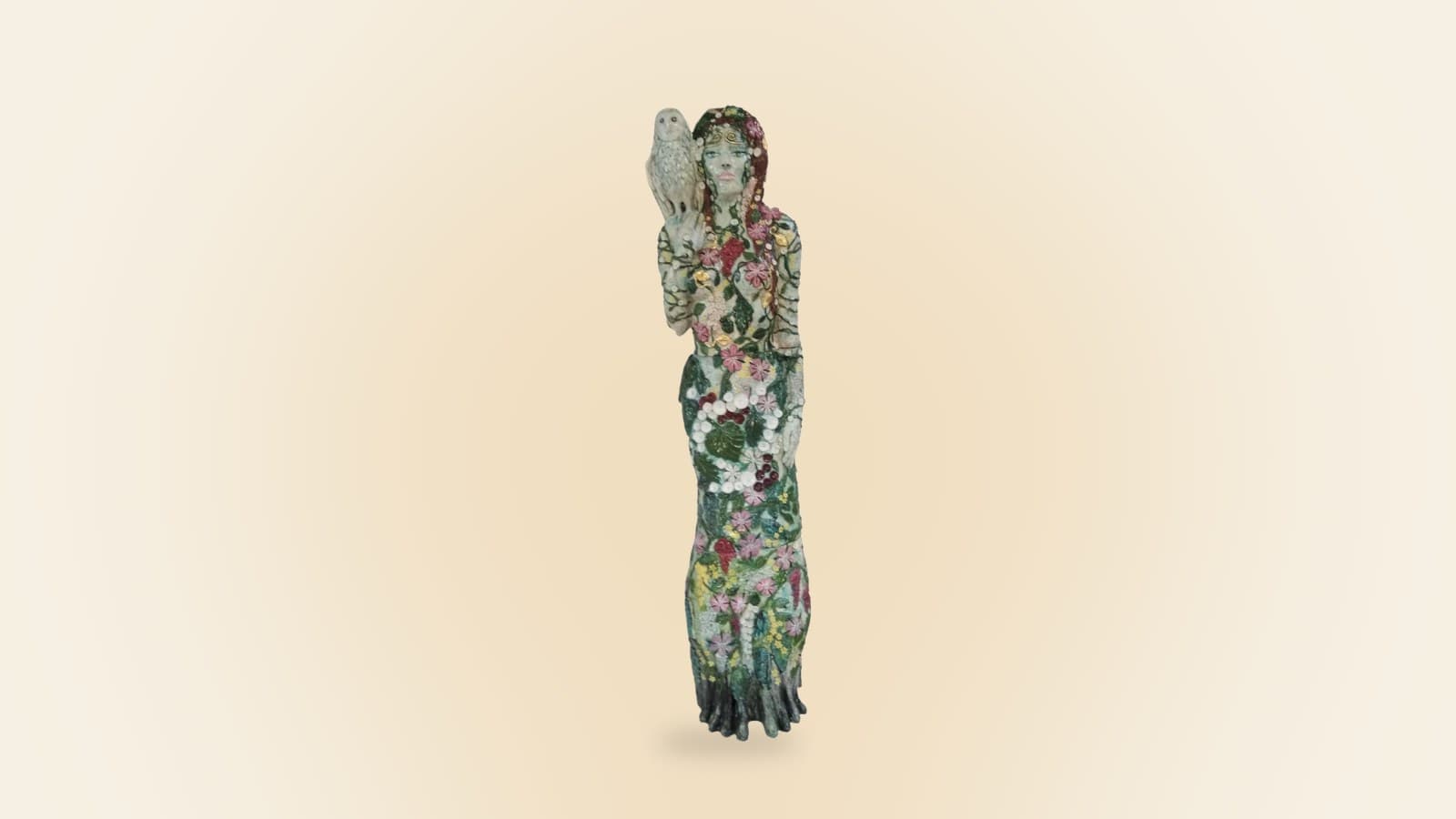
Blodeuwedd begins as a solution to somebody else’s problem. In the Fourth Branch of the Welsh Mabinogi, Math and Gwydion make a woman from flowers so that Lleu Llaw Gyffes can marry despite a prohibition imposed by his mother. She later loves Gronw Pebr, conspires against Lleu and is transformed into an owl. The tale links creation, desire, violence and punishment. Calling her a flower goddess is a modern interpretation: the episode itself presents an enchanted woman, without describing a cult dedicated to her.
What does Blodeuwedd mean?
The name preserves that movement between flowers and a bird. Peter C. Bartrum’s Welsh Classical Dictionary distinguishes the earlier form Blodeuedd, meaning flowers collectively, from Blodeuwedd, which he renders flower-like. Flower-face is another familiar English rendering of Blodeuwedd. These translations are ways of explaining a Welsh name, not separate titles with separate divine functions. Charlotte Guest’s nineteenth-century translation uses Blodeuwedd throughout the episode, so an English reader can miss distinctions visible in discussion of the Welsh forms. The spelling adopted here follows the name of the sculpture.
The Mabinogi and Blodeuwedd’s flower creation
The story belongs to Math fab Mathonwy, the Fourth Branch. In Guest’s translation, Arianrhod first denies her son a name and then arms unless she supplies them herself; Gwydion obtains both through tricks. Her next prohibition excludes a wife from the race then living on earth. Making a woman from flowers circumvents this restriction. Read in sequence, Blodeuwedd’s arrival continues a struggle over Lleu’s future. This narrative context matters: she enters a chain of magical solutions already devised for him, rather than appearing independently to announce her own purpose.
Guest names the flowers of oak, broom and meadowsweet. Math and Gwydion use their enchantments to produce a maiden, name her and arrange the marriage. The three plants belong to this particular act of making. The passage does not explain them as a universal code of maidenhood, motherhood and old age. Reading the flowers as a beautiful but precarious beginning is an editorial interpretation of the scene. It keeps their literary function in view while leaving room for a contemporary artist to return to the image of a person assembled from living blossoms.
Lleu, Gronw and the plot
The marriage receives a geographical setting. Math gives Lleu the cantref of Dinoding, and Guest places his court at Mur y Castell, associated in her account with Ardudwy. Gronw comes from Penllyn and reaches the court after hunting a stag by the river Cynfael, written Cynvael in Guest. These are names within the translated narrative, not directions to an excavated home of Blodeuwedd. They make the encounter local and particular: a visiting hunter is welcomed as evening falls, and hospitality becomes the occasion for a relationship that overturns the household.
Guest describes love arising in both Blodeuwedd and Gronw as they look at one another. They spend time together and discuss how they might remain together permanently. Gronw asks her to discover how Lleu can be killed, disguising the inquiry as loving concern. The narrator therefore gives us mutual desire and a deliberate conspiracy. A modern reading may question the marriage arranged at her creation, but that question does not erase the attempted killing. Both features can remain visible, without turning her into either an uncomplicated villain or an entirely innocent emblem of freedom.
Lleu’s vulnerability depends on carefully combined conditions. The weapon must be made over a year, with work confined to the Sunday religious observance described by Guest. He cannot be killed inside or outside a house, on horseback or on foot. He explains a position with one foot on a bath’s edge and the other on a goat beneath a specially prepared covering. Blodeuwedd persuades him to demonstrate it. Gronw strikes from concealment; Lleu cries out and flies away as an eagle. His disappearance is a transformation, rather than the end of his story.
Lleu’s return and Blodeuwedd’s flight
Gwydion subsequently finds the suffering eagle and brings Lleu back to human form. Recovery is followed by pursuit and redress. Blodeuwedd flees with her women, who drown while looking behind them; she alone escapes the water and is overtaken. The tale explains the lake’s name through their deaths. Bartrum records the later geographical association with Llyn y Morynion near Ffestiniog. Such a connection belongs to the story’s reception in the landscape. It does not independently demonstrate that the narrated events occurred at that lake or that a historical woman became a bird.
Why is Blodeuwedd turned into an owl?
The owl transformation is explicitly imposed by Gwydion. In Guest, he says that he will do worse than kill her: she must avoid daylight, and other birds will attack and drive her away. The narrator then explains Blodeuwedd as a word for owl. Here the bird carries exclusion and punishment, as Gwydion’s sentence makes explicit. Bartrum also cautions that this owl word does not seem to remain in current use. The tale’s explanation should therefore be read in its literary and historical setting, rather than treated as a claim about everyday Welsh today.
Blodeuwedd in modern theatre
Later theatre makes that interpretive openness concrete. Theatr Cymru’s account of Saunders Lewis’s Blodeuwedd presents her as frustrated and confined, while Llew wants an heir. Its production history records performances in 2013 and 2014. This is a documented modern dramatic treatment, not an extra chapter of the Mabinogi. The emphasis shows how adaptation can give weight to a character’s predicament while retaining the dangerous plot. Literary reception therefore supplies a useful bridge to sculpture: each medium chooses what to hold before its audience from a story that contains incompatible desires.
Frequently asked questions
Who is Blodeuwedd in the Mabinogi?
She is the woman Math and Gwydion create from flowers as a wife for Lleu Llaw Gyffes in the Fourth Branch. Her affair with Gronw Pebr leads to a plot against Lleu and her eventual transformation. The text supplies a literary story; calling her an ancient worshipped goddess requires evidence beyond this episode.
Which flowers were used to make Blodeuwedd?
Guest’s translation specifies oak, broom and meadowsweet. They are the ingredients of Math and Gwydion’s enchantment. The text does not assign each plant a separate divine role. The atelier catalogue documents ceramic flowers on this sculpture but does not identify their species, so the literary plants should not become an unsupported description of the work.
Why does Blodeuwedd become an owl?
Gwydion imposes the transformation as punishment for her actions against Lleu. In Guest’s account, avoidance of daylight and hostility from other birds are central to the sentence. Interpreting the owl only as a positive emblem would overlook the meaning that the transformation has within this particular narrative.
What does the name Blodeuwedd mean?
Flower-face is a familiar rendering. Bartrum gives flower-like for Blodeuwedd and distinguishes Blodeuedd, meaning flowers collectively. The narrative also connects Blodeuwedd with an owl word. These related explanations deserve to be kept together, rather than replaced with an invented title such as an ancient goddess of spring.
See the sculpture: Blodeuwedd
Sources
- The Mabinogion, translated by Charlotte Guest, 1877, Math the Son of Mathonwy: creation, marriage, plot and transformations/Math_the_Son_of_Mathonwy)
- Peter C. Bartrum, A Welsh Classical Dictionary, entry Blodeuedd, Blodeuwedd, pp. 52–53, National Library of Wales: names and landscape reception
- Visit Wales, Welsh myths and legends, Blodeuwedd section: flower-face rendering
- Theatr Cymru, Blodeuwedd by Saunders Lewis: modern dramatic interpretation and production history
- Sculpture facts: atelier RHEAsilvia